
April 2025 CPI eases on gasoline. Shelter and auto insurance inflation still under wraps.

Eric Pachman
Published
May 13th 2025
Eric Pachman
Published
May 13th 2025
April 2025 year-over-year inflation (CPI) eases to 2.31%
This morning the Bureau of Labor Statistics released the April 2025 US CPI report for All Urban Consumers (CPI-U). Overall CPI-U was reported at 2.31% year-over-year (YoY) for April, down eight basis points from 2.39% YoY last month.
As a reminder, Bancreek publishes two visualizations that can help you explore CPI-U in granular detail. Both of these visualizations have now been updated through April and are embedded below:
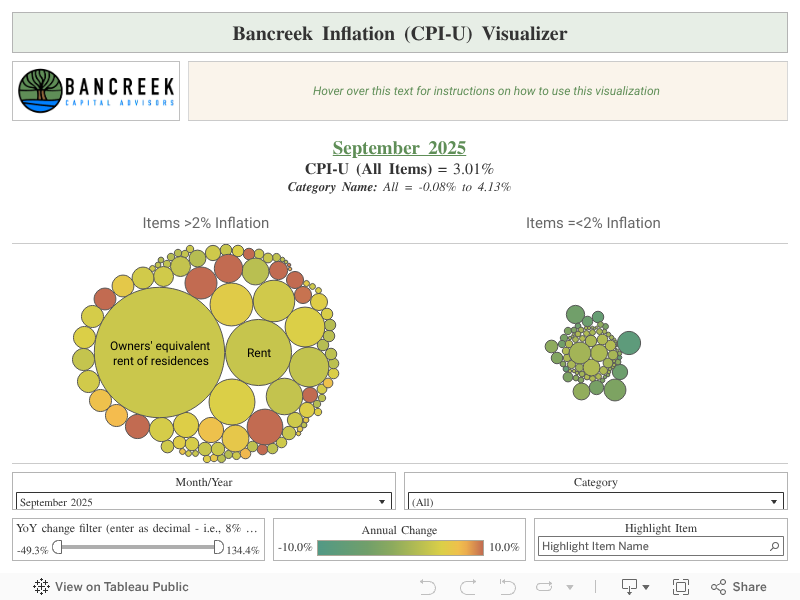
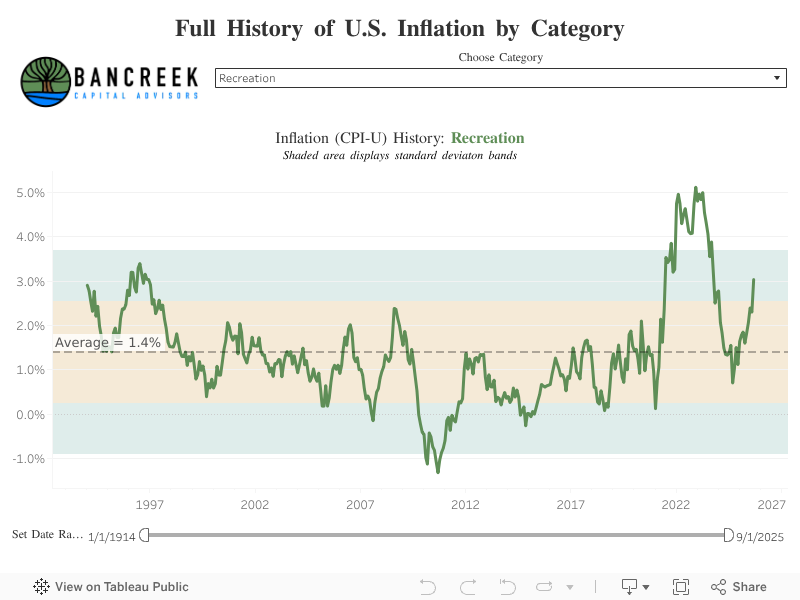
This post hopefully will further assist in your analysis of the moving parts underlying this month’s CPI report. Its goal is not to provide a comprehensive analysis of the nearly 180 items we track (that’s what the visualizations are for), but rather just to point to the most meaningful changes from one month to the next.
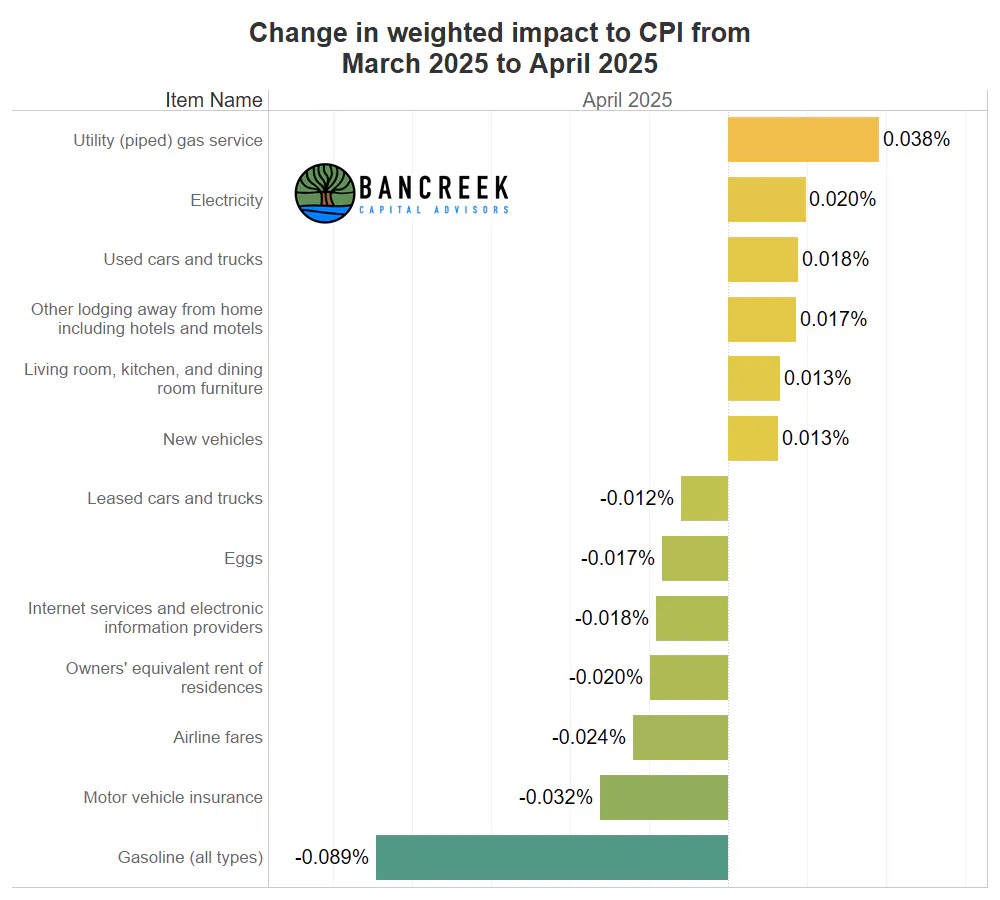
To perform this analysis, we track a measure we call “inflation impact,” which we calculate by multiplying each item’s YoY inflation by its weight in the prior year period. You can think of this as “weighted inflation” as opposed to the “unweighted inflation” that is more commonly reported by the media. Each month we take the weighted inflation of each item we track in CPI-U and then sum them up to overall CPI-U. Then we compare these weighted inflation numbers from one month to the next to see what drove the sequential increase or decrease. In this way, we can precisely identify the most significant drivers in the change in YoY CPI-U from one CPI report to the next.
Gasoline drives easing in headline CPI
On the surface this month's CPI analysis is quite straight-forward. As mentioned above, year-over-year headline CPI dropped eight basis points to 2.31% in April. When we work through the math, we find that the increase in gasoline's deflation this month put nine basis points of downward pressure on CPI. That means that all other items netted out to an insignificant one basis point of upward pressure on CPI this month.
Source: Bancreek Capital Advisors, LLC
Of course, the devil is in the details. Not to worry, we'll study that devil in more depth after we complete our discussion on gasoline.
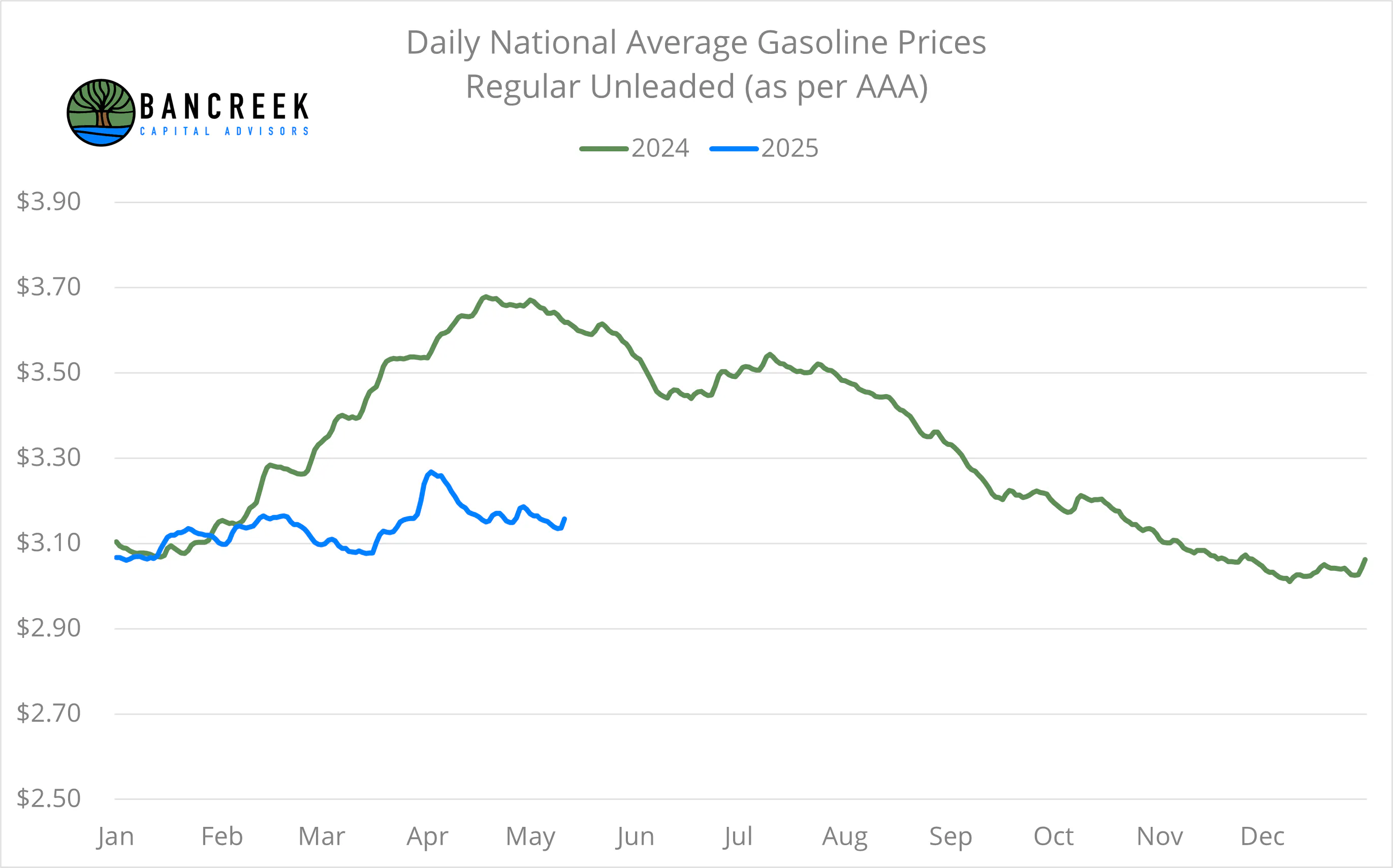
As a reminder, we published a post several months back analyzing the change in gasoline's reported CPI index values compared to the change in monthly average AAA retail gasoline prices and found an almost perfect correlation between the two. April was no exception to the rule, with CPI showing gasoline down -11.8% YoY and average AAA retail gasoline prices down -12.1% YoY. As shown below, gasoline prices actually rose on a month-over-month basis (up 2.5%), but nowhere near the level of normal seasonality seen in 2024. As a result, YoY gasoline deflation accelerated from -9.8% last month to -11.8% this month.
Source: Bancreek Capital Advisors, LLC analysis of data from Bloomberg
If you spent a few moments inspecting the above chart you may have noticed that unless the blue line (2025) starts declining from here, the gap between the green line (2024) and blue line looks like its going to contract going forward. Actually, when we do the math assuming average gasoline prices through May 12th hold through the month, we forecast gasoline deflation to increase ever so slightly to -12.7% in May. But then as we progress through the summer and into the fall, the green line starts closing in on the blue line (at least where it stands now). Without anymore sequential gasoline deflation through the year, all YoY gasoline deflation could be gone by October.
Why is this consequential? Because in April gasoline's weighted inflation impact was -43 basis points. In other words, if this had been zero, headline CPI this month would have been 2.74% instead of 2.31%.
Now, clearly we wouldn't bet on gasoline staying stable through the rest of the year. That's just not how this ultra-volatile item behaves. But we offer this analysis just so you understand what is at stake for headline CPI as we move through the summer and into the fall. In order for us to preserve the -43 basis points in weighted inflation benefit we had this month, we will need average AAA retail prices to be $2.80 per gallon in October. If consumers are really tightening their belts, that's not too much of a stretch, in our view. But if historical drivers hold for gasoline, it does imply that both oil prices drop into the mid-$50s per barrel and crack spreads (i.e., refining margins) drop to ~$20 per barrel. Levels this low for both of these drivers of gasoline prices haven't been seen at the same time since 2020, which doesn't seem like a year anyone wants to repeat.
Shelter inflation continues to cooperate
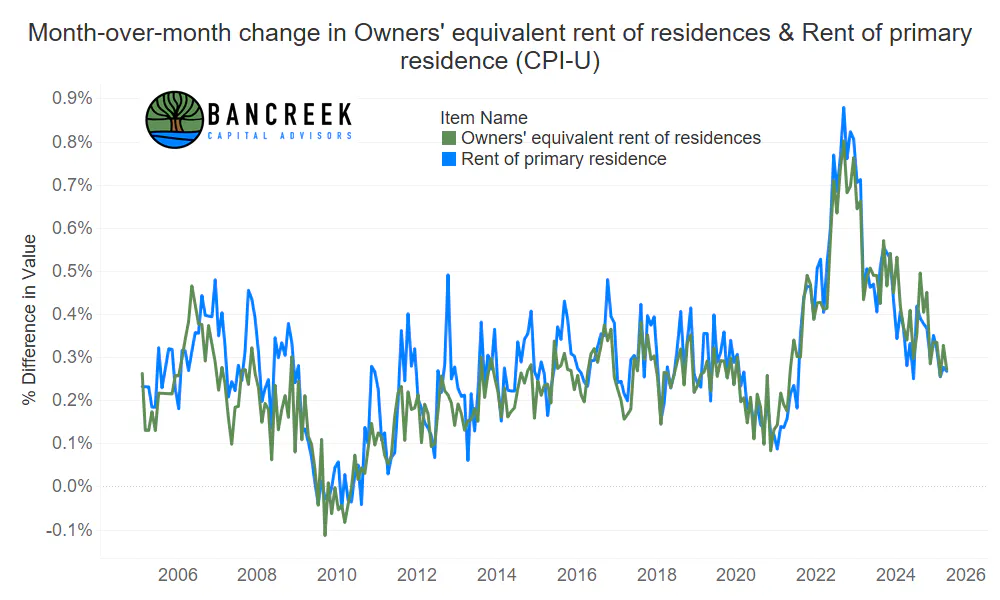
Now let's move to the details, which point to the underlying "quality" of the CPI print. First off, shelter inflation remained subdued, which is wonderful news given how massive shelter's weight is within the CPI measure. As shown below, both Owners' equivalent rent of residences ("OER") and Rental of primary residences ("Rent") inflated at just 27 basis points MoM in April 2025, right around their historical average.
Source: Bancreek Capital Advisors, LLC
If we annualize 27 basis points of MoM inflation, we get an annualized run rate of 3.3%. In April, YoY inflation for OER and Rents was still 4.3% and 4.0, respectively. As such, if these two heavyweight items can hold this level of sequential inflation, we should still expect shelter to act as a disinflationary tailwind all the way into early 2026. When we model this out going forward, we see a maximum of -32 basis points of easing by March 2026 if they can both hold this month's sequential inflation level for the next 11 months, after which YoY shelter inflation would stabilize. While this is great news, we won't see much of this impact until the fall, due to the cycling of tougher comps through the summer. But if shelter inflation can remain under wraps, this is a good guy that should help ease core inflation towards the end of 2025.
Another month of muted auto insurance inflation!
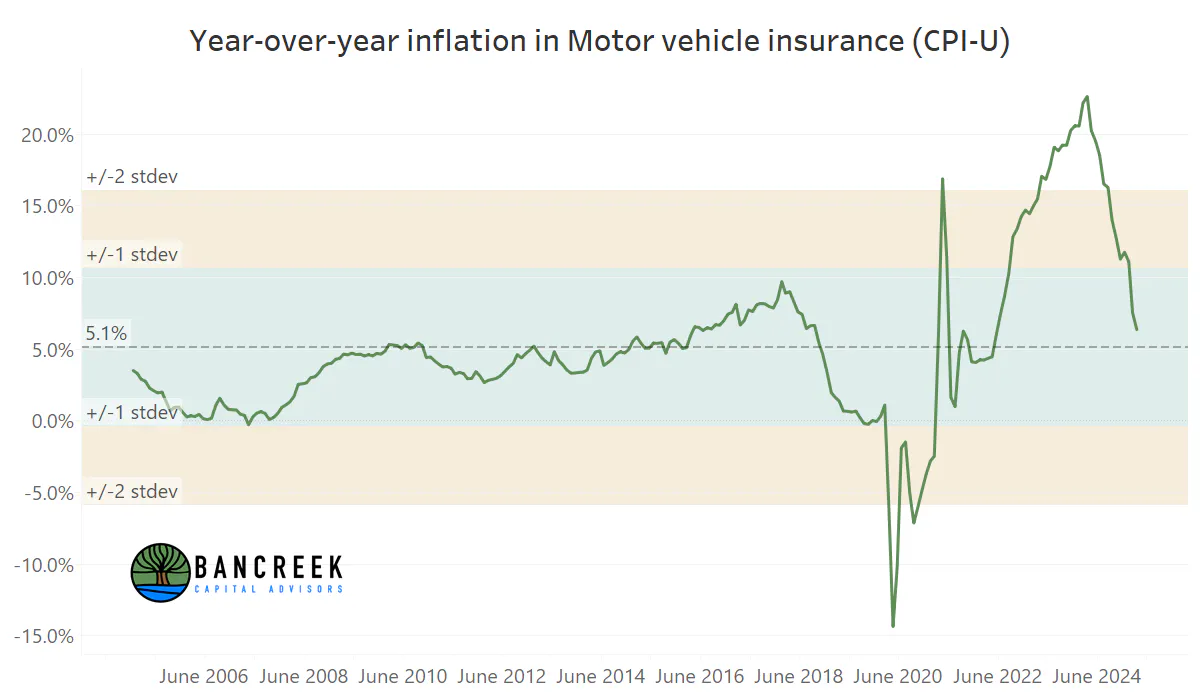
Oh how joyous it is when we download the data and see that Motor vehicle insurance inflation is NOT launching into the stratosphere. This month it came in at a pedestrian +25 basis points MoM, which pulled down its YoY inflation to 6.4%. As shown below, that's the lowest inflation this item has registered since June 2022.
Source: Bancreek Capital Advisors, LLC
While this was great news for April 2025, current inflation for this critical item is now closing in on its 5.1% historical average. This means that the tailwinds that this item have been adding to the recent easing in CPI could soon be over (unless of course, it corrects well below its historical average). If it does level off at 5.1% YoY, we're only looking at another four basis points of potential deflationary tailwinds to CPI from auto insurance. In other words, the juice has largely been squeezed from this item. Also, given its highly volatile recent history, we are not out of the woods yet. Motor vehicle insurance has been known to spike after a few quiet months. As such, we'll continue to keep a close eye on this item to make sure the tailwinds it has been providing don't turn into headwinds.
Tariff impacts are notably absent from the data
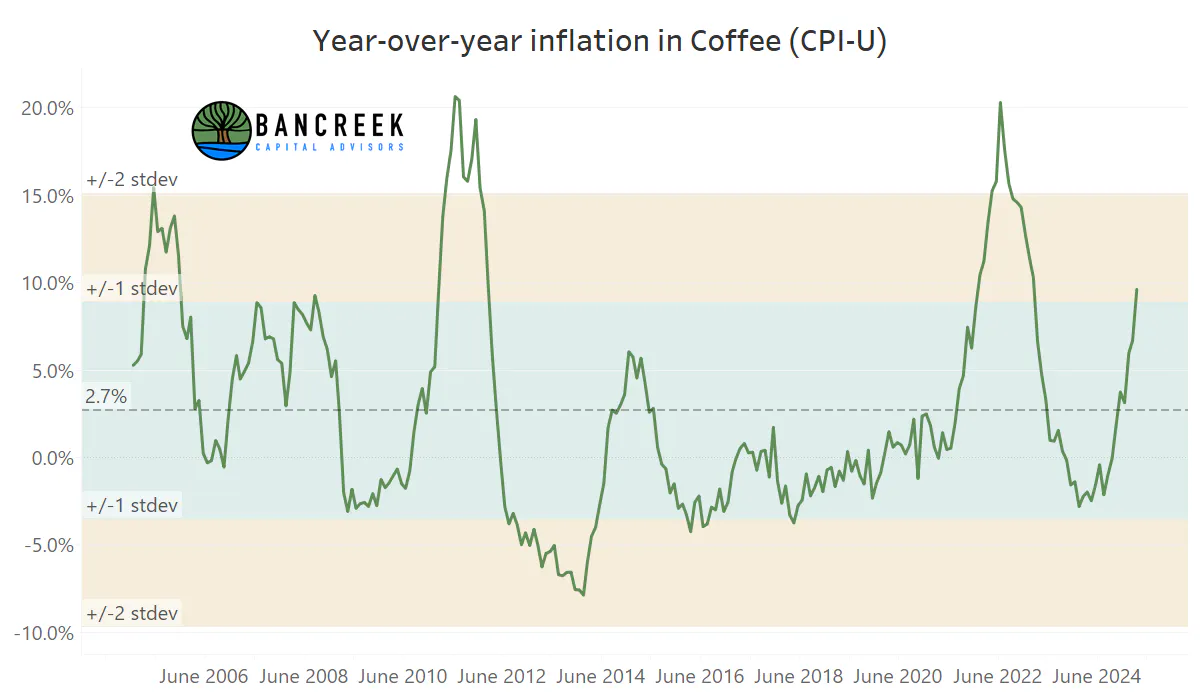
Looking at the news flow coming into today's print it appears that many folks were looking for some early signs that tariffs are flowing through to CPI. After looking through our data visualization, we're hard pressed to see any definitive evidence that tariffs have driven prices of any material items higher. The one item really stands out, which if we really had to, we could at least partially pin on tariffs is coffee. But with a weight of just 0.18% coffee just isn't large enough to put much pressure on headline CPI.
Source: Bancreek Capital Advisors, LLC
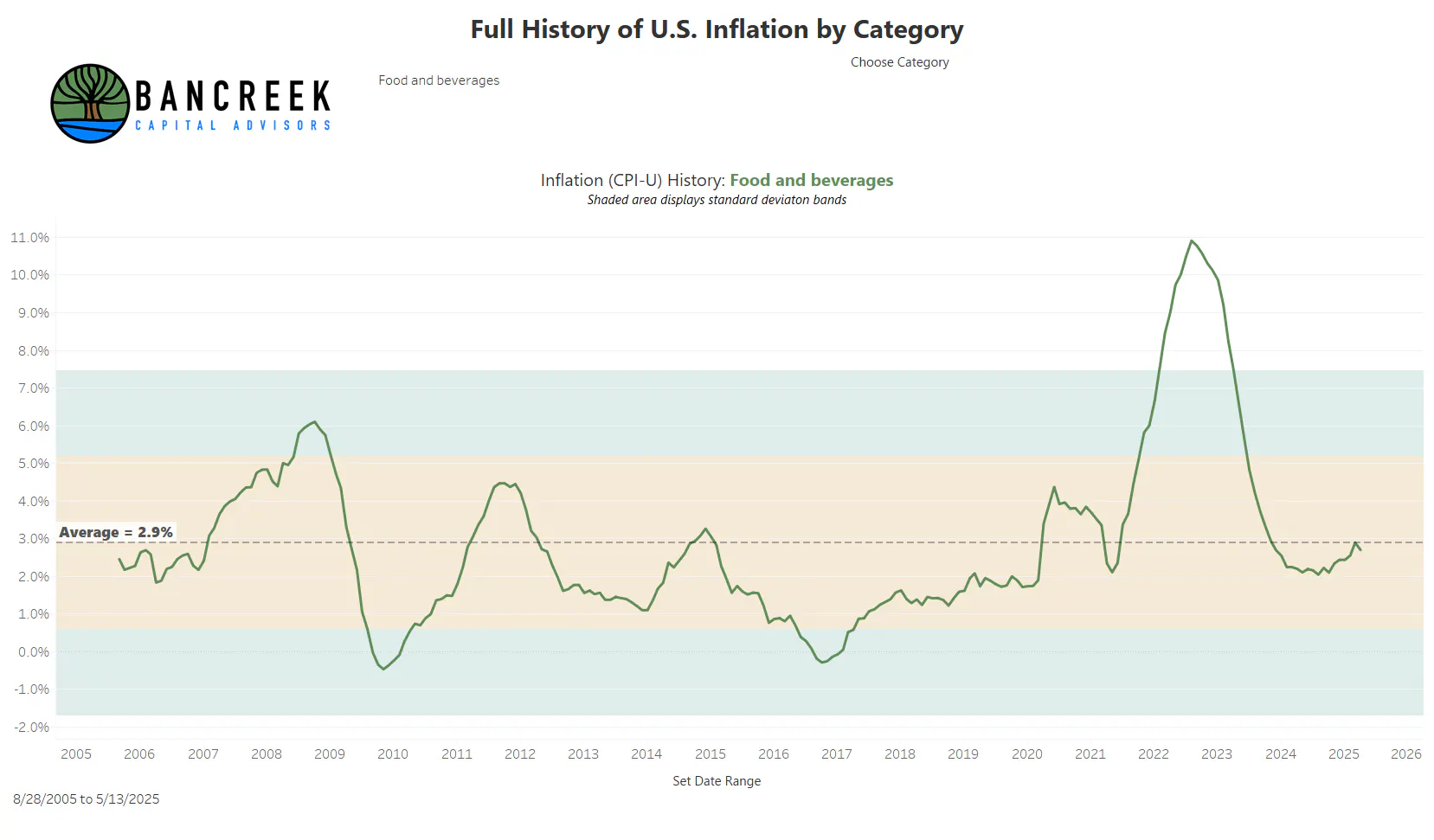
Even more interesting is that when we look at the Food and beverage category, YoY inflation fell from 2.9% last month to 2.7% this month. As shown below, that's the first decline in the Food and beverage index since October 2024. Note that we used our Full History of U.S. Inflation by Category data visualization to create this chart. Feel free to play with this if you want to see additional history for this category all the way back to 1914.
Source: Bancreek Capital Advisors, LLC
This just goes to show that CPI data does what it wants to do rather than following the consensus narrative. Even more reason to use our tools to drill into the data to have any chance at staying one step ahead of the Fed.
Where is inflation going from here?
Yes, this is a silly question, but one we must attempt to answer. It's silly because what we know about tariffs is literally changing every day. And these aren't small changes. It's more like whiplash. Or a cat chasing a laser pointer. If there is anything we are confident saying it's that no one should try to predict the impact of tariffs on CPI or PCE with any confidence.
But this doesn't mean that we are flying blind. As we have detailed in this post, if shelter can remain at its current sequential inflation, we could see another ~30 basis points shaved off CPI in the next year. Meanwhile, the tailwind coming from auto insurance is largely tapped out. On the flip side, unless gasoline prices decline considerably from where they stand now, that could put around ~40 basis points of upward pressure on headline CPI. Put it all together and it looks like there could be upward pressure on CPI into the summer, which could then be partly offset by a shelter tailwind toward the end of the year.
But as we know, it's irrational to expect stability when it comes to CPI, especially with tariffs looming like a menacing cloud over all our analysis. Hopefully the sensitivity analysis we have quantified in this post at least helps size some of the larger items for which we have a bit of visibility.
Enjoying this post?
Tell others about it.

Bancreek's Actively Managed ETFs
If you are interested in learning more about Bancreek Capital Advisors' actively managed ETFs click the link below
Learn MoreMore articles like this
Fetching Related Posts
There are no other articles tagged with Research