
Key Takeaways from the December 2024 Nonfarm Payrolls Report

Eric Pachman
Published
January 10th 2025
Eric Pachman
Published
January 10th 2025
Nonfarm payrolls surge by 256k in December. Private payrolls up 223k.
This morning the Bureau of Labor Statistics (BLS) released December 2024 Nonfarm payroll data. Total nonfarm payrolls rose by 256k, inclusive of a 223k increase in Total private jobs. Today's release also included a two-month payroll net downward revision of -8k jobs. This downward revision lowered November 2024's month-over-month job additions to 212k jobs, 182k of which were private jobs.
Before we dive into our take on all the moving parts in today's Nonfarm payroll data release, we'll first share that we've updated the Bancreek U.S. Employment Data Treemap with today's data (embedded below). So, if you are the type that just wants the visualization and less words, here you go. Also, as a heads up, it usually only takes us 10-15 minutes to update and repost this visualization on bancreek.com, versus a few hours to gather, write, and publish our thoughts. So, if you want to play with this viz as soon as its ready on Nonfarm payroll data release day, make sure to bookmark this page.
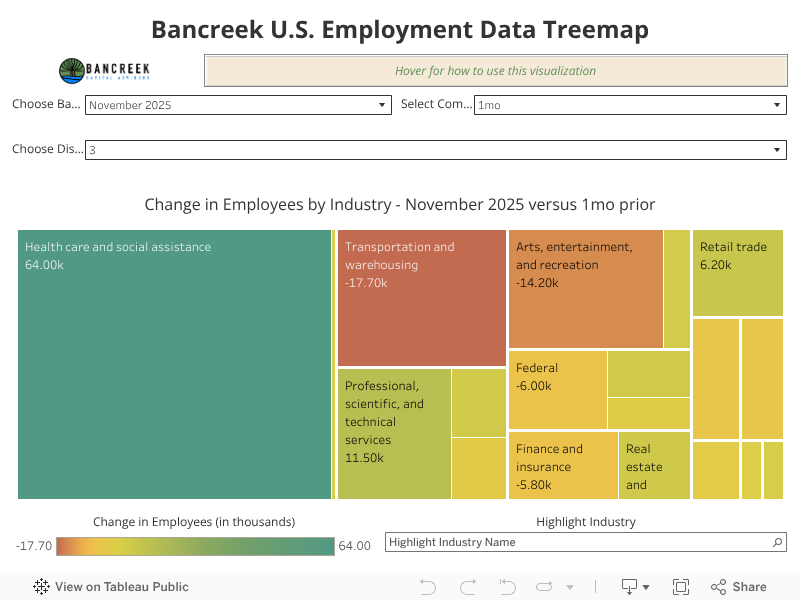
Health care, restaurants, and government keeps churning out new jobs
Clearly, today's +256k print took people by surprise, as consensus expected "only" 165k new jobs. We suspect people will look at this number and make blanket statements about how strong the job market is. But poke around in our payroll data viz and you will start to realize the story is more nuanced. For pretty much the past year there have been three reliable sources of job growth:
- Health care and social assistance
- Accommodation and food services
- Government
Through November 2024, these three industries added 1.57 million jobs over the prior 12-months. That's out of a total of 2.27 million job adds for all establishments tracked by the BLS in its survey. So, through November, these three industries were responsible for 69% of all new jobs added over the prior year.
But to understand how truly imbalanced this growth rate is, we need to look at the absolute number of jobs in these three industries, and compare that to total nonfarm payroll jobs. The answer is that back in November 2023, there were just over 59 million jobs across these three industries, compared to just over 157 million nonfarm jobs. That's a ratio of just 38%. This means that 69% of all new jobs over the prior year came from just 38% of the economy.
This is what's really going on. For those basketball fans out there, the U.S. job market is the equivalent of a "super team," the likes of which was first created when LeBron James "took his talents" to South Beach to join forces with Dwyane Wade and Chris Bosh. Of course this worked out quite well for the Miami Heat, as they went onto win two championships with their "Big 3". But several NBA teams have tried to follow the same unbalanced, high concentration risk, super team strategy with much worse results (e.g. L.A. Clippers, Phoenix Suns, Brooklyn Nets, Philadelphia 76ers... the list goes on). The problem is with such unbalanced teams, you are just one or two injuries away from planning your next lottery pick. These teams are strong when their superstars are strong, but they are usually not resilient.
So in December, the Big 3 of the U.S. job market was clicking on all cylinders, throwing alley oops to each other and having a blast on the court. These three industries added 138.3k jobs, which was 54% of the total nonfarm job adds in the month. Should this magnitude of job adds have been a surprise? Not at all, as the average job adds per month over the past 12-months for these three industries was 131k coming into the month. So, no surprise here... just the Big 3 doing what we pay them to do.
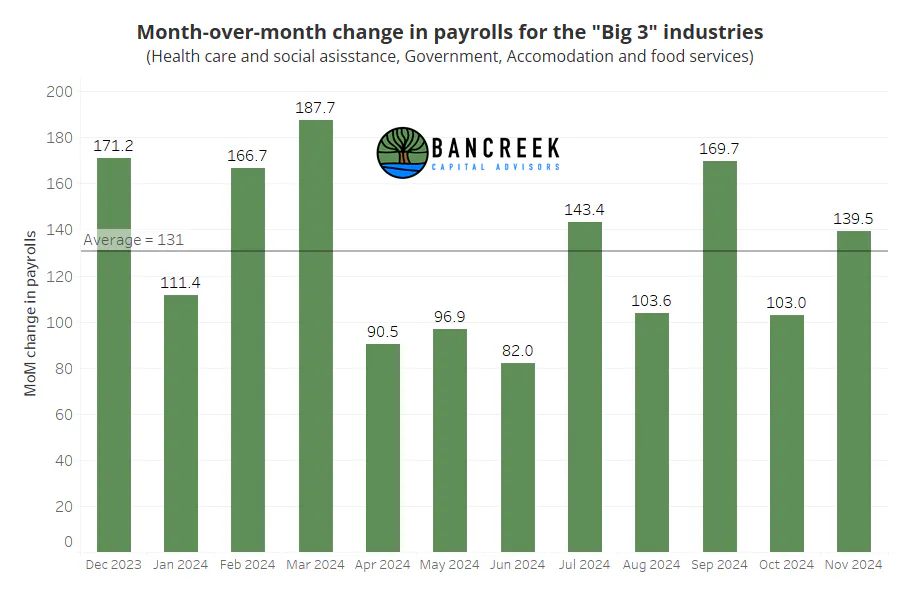
Source: Bancreek Capital Advisors, LLC
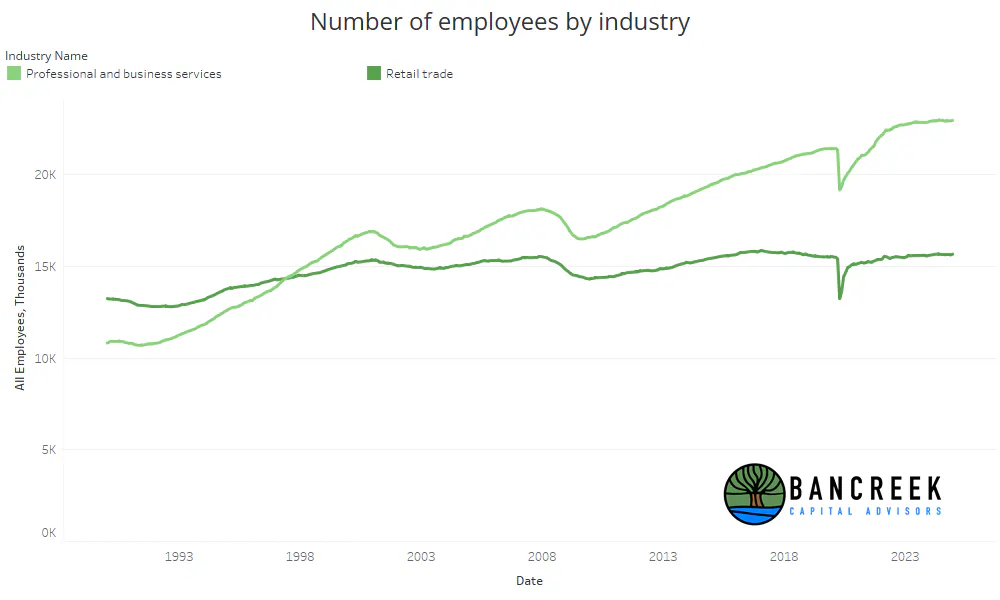
That means the surprise came from the role players, who stepped up to add another 117.7k jobs, far above the 58k average job adds per month they were good for over the prior 12-months. The standout amongst the role players was Retail trade, which added 43.4k new jobs in December and Professional and business services which added 28k jobs in the month.
If you had just set your expectations for these two industries based on the average number of job adds they have had over the past 12-months, you would have expected them to together add just 12k jobs in December. So, at 71k job adds, they really overachieved. In fact, these 59k extra jobs explain the entire difference between the average run rate on total nonfarm payrolls over the past 12 months and December's far stronger number. In other words, all the other role players netted out to perform in line with their "season averages."
The U.S. job market is clearly strong, but unbalanced
Hopefully this post, and our free data visualization, has provided you with some context to add shades of grey to the usually black and white media portrayal of complex economic data sets. Our conclusion is that the U.S. job market is quite strong, so long as:
- There are no major disruptions to the health care (or given the current incentives, maybe it's more appropriate to call it "sick care") system,
- we keep adding government jobs, especially at the local and state level, which as we have written, have been the real drivers of government job growth, and
- people keep channeling their disposable income into eating out.
As long as these three dynamics are not disrupted, the Big 3 can keep flexing its muscle, dragging the U.S. economy along for the ride. While the job adds in Retail trade and Professional and business services were interesting, we're not going to go ahead and sign these guys to a fat new contract based on one good game. Time will tell if December was an outlier. As shown below, the long term trend charts for both certainly don't inspire much confidence. Plus, it's hard to not get a touch concerned specifically with Professional and business services with AI potentially nipping at the heels of many of those employees.
Source: Bancreek Capital Advisors, LLC
Are we actively trying to injure two of our star players?
Obvious AI-related labor risks aside, we can't help but wonder if momentum is building to kneecap two of the U.S. economy's Big 3.
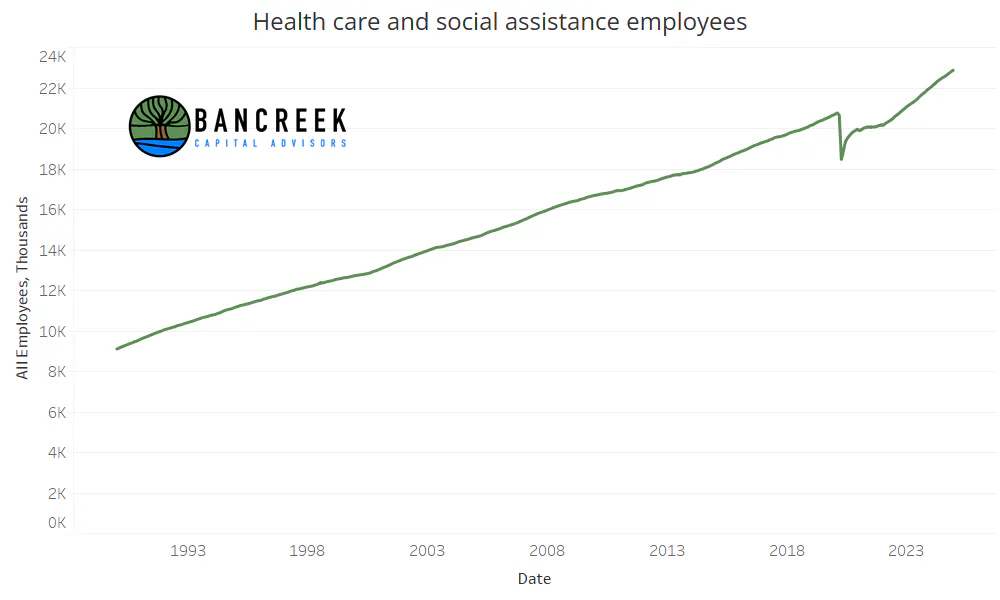
First on health care, frustration appears to have reached a boiling point on how health care works in this country. Our take is that the major players within our U.S. health care system used to hide behind its complexity, relying on the idea that it is just simply too tied up in knots to fix. That was until the murder of United Health's Brian Thompson brought this complexity, and the vengeful rage it has incited, to the top of our nation's collective awareness. The odds seem higher then they have in a long time that policy will finally start to tackle some of the structural issues in health care that has underpinned the relentless rise in health care jobs over the past 35 years (see next chart). Maybe health care really is too complex to fix. But the political incentive is there to do it now, more than we can ever recollect. If major structural changes do come to how the health care supply chain makes its money, this Health care and social assistance jobs chart could look quite different over the next 10 years.
Source: Bancreek Capital Advisors, LLC
Then there are government jobs, which DOGE clearly has in its crosshairs. Of course, all DOGE can do (if it really can do anything) is tinker with Federal jobs, and the data clearly shows that Federal jobs are not the source of Government job growth.
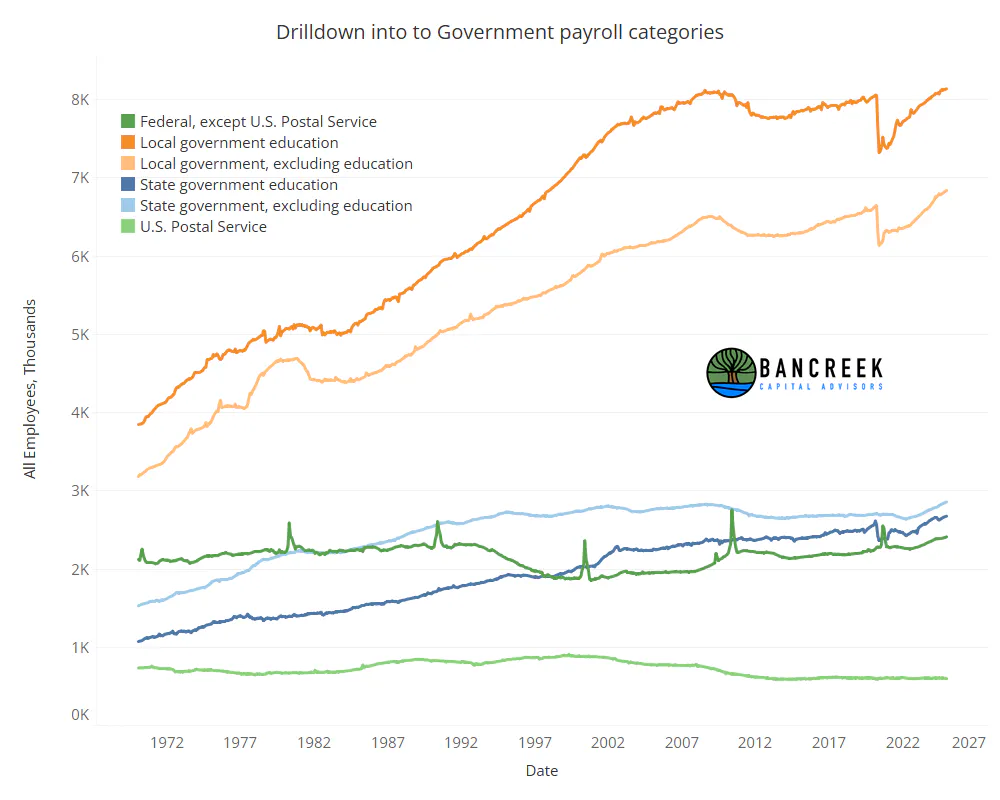
Source: Bancreek Capital Advisors, LLC
But in our view, the real impact of DOGE the perception it creates. How many elected local and state officials will line up behind Elon Musk in the coming years and look to eliminate jobs at the state and local level, and then leverage these actions to appeal to an Elon-infatuated electorate to elect them to higher positions?
Both of these logical trains of thought may seem a bit out there, but we just provide them to make the point that "healthy" jobs prints going forward are ever more reliant on the superstars delivering given how unbalanced job growth has been recently. And it certainly does seem like sentiment is shifting to make it a bit more challenging for two of our three stars to put up the same stats going forward.
Enjoying this post?
Tell others about it.

Bancreek's Actively Managed ETFs
If you are interested in learning more about Bancreek Capital Advisors' actively managed ETFs click the link below
Learn MoreMore articles like this
Fetching Related Posts
There are no other articles tagged with Research