"It's the Economy, Stupid" - The Market Just Doesn't Know It Yet

Eric Pachman
Published
September 19th 2025
Eric Pachman
Published
September 19th 2025
Trying to reconcile U.S. markets with U.S. macro data had us thinking of the old maxim, “it’s the economy, stupid.” Traditionally this has been a reminder to politicians that voters care most about growth and jobs. But does it apply to markets?
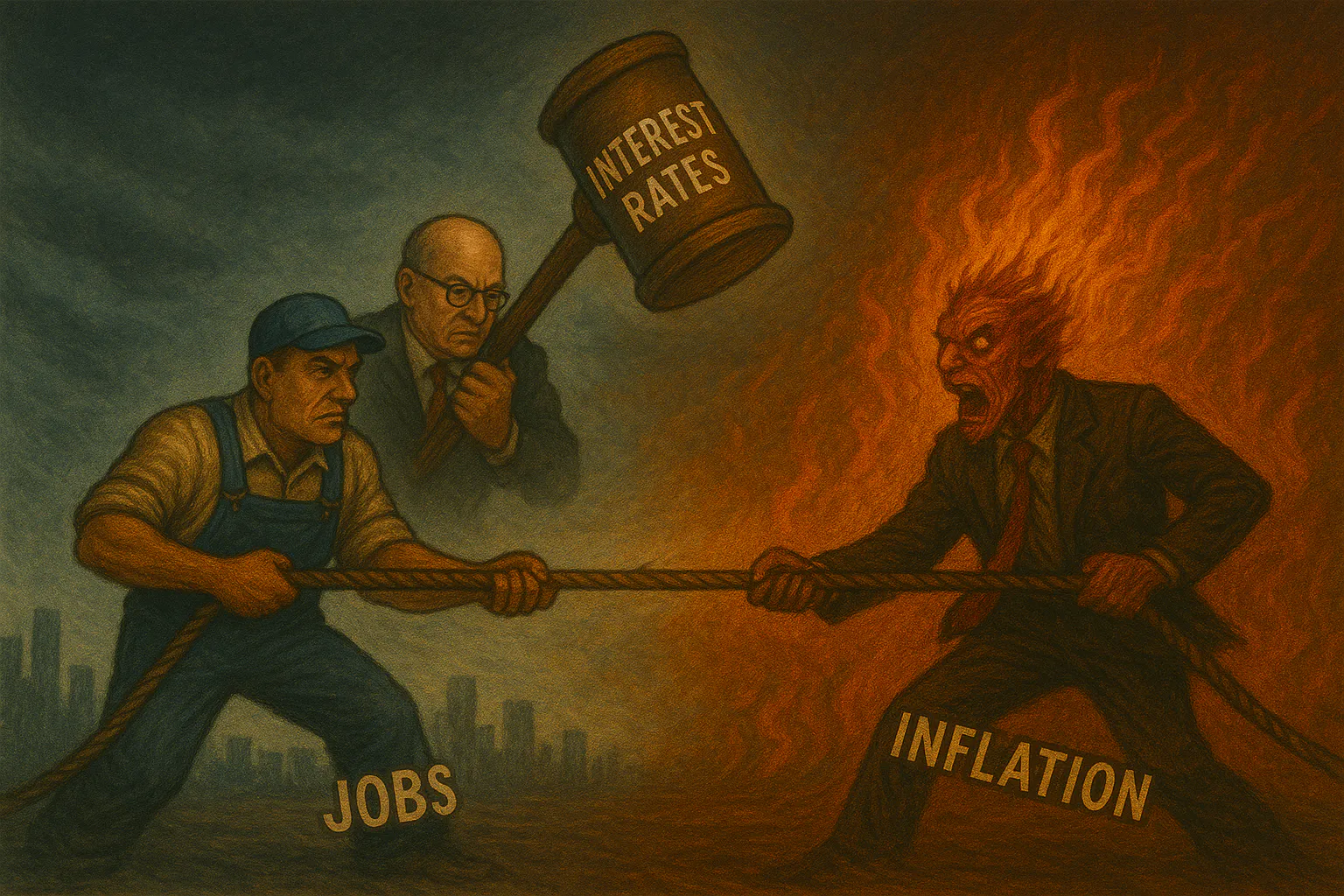
Over the long run, markets have tracked economic cycles. Yet today feels different. Investors seem perfectly willing to look past a somber Chair Powell reminding us that the Fed can’t fight inflation and support labor markets at the same time — monetary policy only points in one direction at once. Instead, markets chose to celebrate the official start of the easing cycle.
At the moment, it’s clearly not about “the economy, stupid.” Rather, “it’s the rates, stupid.” And the Fed has made clear it’s more focused on cushioning the downside in employment than avoiding further upward pressure on inflation, which is getting people quite excited about rates.
This brings us to the critical question the market can only avoid for so long: will easing rates actually spur job growth the way it has in the past? This has been our refrain since we first started flagging hidden weaknesses in the labor market back in 2024.
The challenge is that these weaknesses were not obvious at the headline level. They were masked by outsized gains in healthcare hiring — a sector that has been carrying the weight of the entire jobs report. Beneath that surface strength, however, the story looks far less robust: non-healthcare industries that have historically driven job growth have been stalled or in outright decline for months.
So, while this may feel like a new narrative for some, it isn’t for us — or for anyone who has been following our work over the past year.
But it’s not too late to dig into the details — and we’ve made that process simple with our interactive nonfarm payroll data visualization. What becomes clear when you do is that the structure of the U.S. economy has shifted dramatically since 2008. (COVID doesn’t really count — that downturn was papered over by trillions in direct stimulus.)
Today, the economy leans far more heavily on service jobs, which historically respond less to rate policy than manufacturing. And healthcare has become the 800-lb gorilla: it accounts for an astonishing 66% of all net new jobs over the past two years, despite representing only 17% of the workforce.
Looking back three decades, healthcare employment has been almost entirely recession-proof, with little to no correlation to monetary policy. In prior downturns, this steady growth acted as a natural buffer.
This time, the story looks very different. ADP data shows a clear slowdown in healthcare job growth, and even the BLS is beginning to reflect the shift. Investor sentiment has turned sharply against the healthcare complex amid rising criticism of opaque and predatory pricing, triggering upheaval in once-lucrative arbitrage-driven business models and pressuring stock prices. Looming Medicaid cuts in January 2027 only add to the headwinds. The reality is that monetary policy cannot create jobs in healthcare, and fiscal policy is now being deployed to slow — or even reverse — them.
Turning to other professional services — e.g., tech, lawyers, accountants, consultants — the outlook isn’t much better. These sectors have been pillars of job creation over the past two decades, yet monetary policy’s ability to boost them is uncertain. AI is the major variable. Even if widespread displacement hasn’t fully materialized, AI adoption could at the very least act as a hiring headwind going forward by allowing companies to cut costs and defend profits without expanding headcount.
Leisure and hospitality, another major source of job growth, is more reactive than primary. Demand in this sector flows from the professional class: when consultants are busy, they book flights, eat out, and fill hotels. When they aren’t, the servers, bartenders, and attendants aren’t needed either. And last we checked, AI doesn’t eat or sleep.
For argument’s sake, let’s assume you share our high-conviction view that monetary policy is losing its ability to translate into job creation. As long as the market is fixated on “it’s the rates, stupid,” this could still be bullish in the near term. One plausible scenario: the easing cycle begins, the labor market continues to weaken, and the Fed responds by cutting even faster than markets currently expect. That alone could fuel another burst of enthusiasm for risk assets as forward rate expectations fall.
We, of course, would shake our heads at this. Why? Because it would only confirm that monetary policy is no longer functioning as intended. Yet the last thing we expect is for the Fed to acknowledge that its tool is broken. Like the proverbial man with a hammer who only sees nails, it will hammer away harder — without realizing it is hammering into thin air.
The inflation implications are hard to ignore. Even before this latest rate cut, the data suggested inflation was heading back into the low-to-mid 3% range simply from cycling tougher comps. If the surge in shelter inflation holds and hospital inflation remains sticky, the “upper 3s” become a realistic possibility within a year. And that’s before factoring in any spike in risk assets — which tend to feed directly into PCE.
Taken together, the picture becomes dangerous: the risk of stagflation is very real, particularly if healthcare employment weakens further as Medicaid cuts hit in 2027. The Fed could cut rates to zero and still fail to offset that dynamic.
To be clear, this worst-case scenario forecast is not our base case. Structural demand for healthcare jobs will persist as America ages, providing an ongoing tailwind for employment in that sector.
But at the same time, demographics cut the other way for inflation. As more Americans retire and exit the workforce, the labor supply will continue to shrink — a steady headwind that places upward pressure on wages and prices. This trend has been unfolding for two decades, but its effects have been muted by strong immigration flows that expanded the labor pool.
Looking ahead, it is difficult to count on immigration playing the same stabilizing role, especially given current policy and sentiment. With these crosscurrents in play, there are simply too many moving parts to issue a definitive call.
What we can say with confidence is that, at some point, the market will shift its focus back from “it’s the rates, stupid” to “it’s the economy, stupid.” And when that happens, our work suggests markets may not like what they find.
If you would like expert guidance or want to discuss market opportunities, feel free to connect with our team.
Enjoying this post?
Tell others about it.

Bancreek's Actively Managed ETFs
If you are interested in learning more about Bancreek Capital Advisors' actively managed ETFs click the link below
Learn MoreMore articles like this
Fetching Related Posts
There are no other articles tagged with Research