
June 2025 payrolls data: A lump of coal wrapped in a pretty bow

Eric Pachman
Published
July 3rd 2025
Eric Pachman
Published
July 3rd 2025
Nonfarm payrolls (NFP) increase by 147k in April. Private payrolls up 74k.
Total nonfarm payrolls rose by 147,000, inclusive of a 74,000 increase in Total private jobs. Today's release also included a two-month payroll net upward revision of +16,000 jobs. This upward revision increased May 2025's month-over-month job additions to 144,000 jobs, 137,000 of which were private jobs.
As always, you can explore all the data yourself using our the Bancreek U.S. Employment data treemap, which can be accessed here and also is embedded below. For an in-depth tutorial on how we built this visualization, and how to best use it, please read our Visualizing Changes in Nonfarm Payroll Data post.
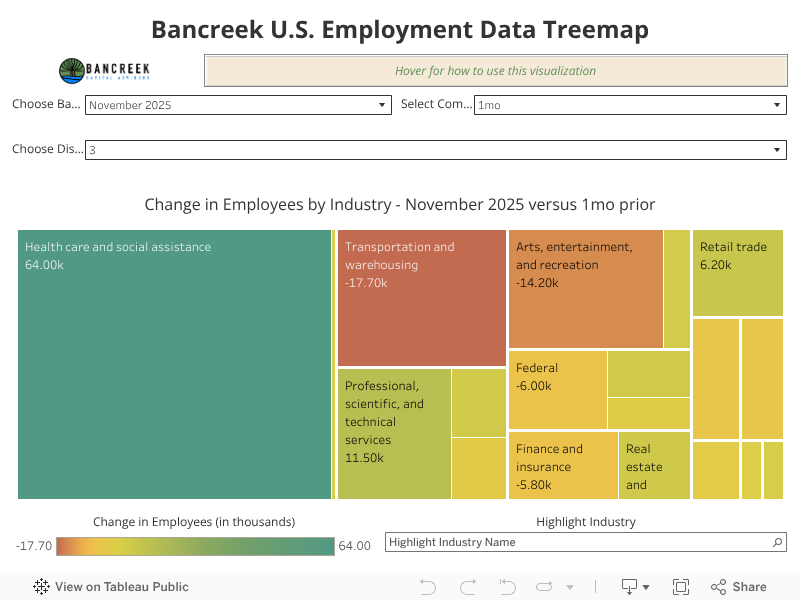
What's inside the NFP gift box? Maybe it's better not to look.
It's quite fascinating watching the reaction to today's nonfarm payroll data. The headline number of +147,000 net new jobs was well above consensus, which expected just 106,000 jobs. So, this is good right? Well, nowadays, that determination is up to you. One could very convincingly argue it's a good number, if one believed that policy makers will point to this number as evidence for the strength of the economy, thereby taking what is just a number without any real meaning and using it to defend a very real and impactful action. This is the perception is reality path, and we can't fault you for following this path.
Or you could go down a different path and try searching for more clues within the data. This is what we are here to help you with, starting with this chart:
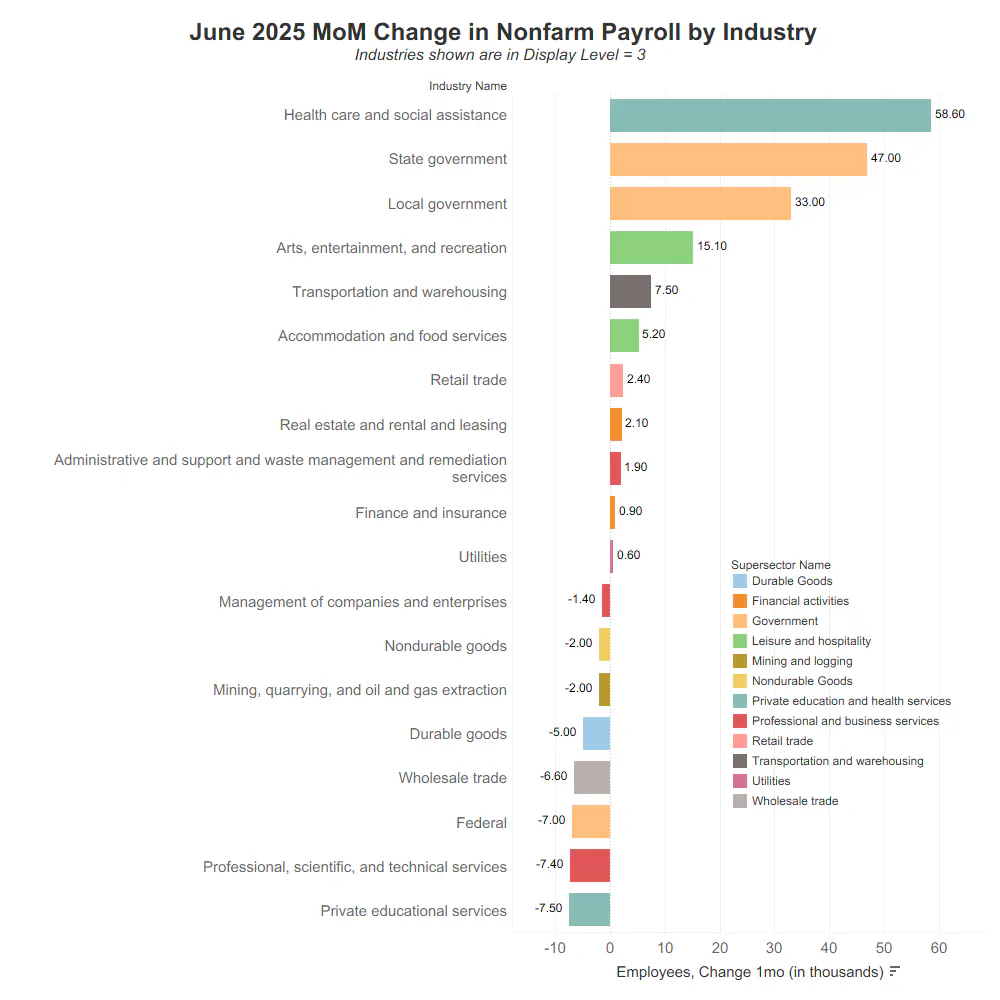
Source: Bancreek Capital Advisors analysis of data from bls.gov
The above chart shows that three industries (at Display Level = 3) were responsible for 94% of all job growth this month. If we ignore State government, Local government, and Health care and social assistance, the rest of the economy only added 8,400 jobs.
These are the clues that lie in this database, whether we like them or not. Now, we have gone a step further to characterize this as a "lump of coal." You may not agree with this. Rather, you may believe health care jobs can continue to disproportionately grow for the next 10 years as they have for the last 35 years (at least). It's also possible that we are entering a renaissance period for state and local funded education (i.e., K-12 public schools and public universities) and this month's +63,500 new jobs between those two industries is just the beginning of a long and prosperous period of job growth. If you believe in both of these things, today's report won't cause much concern. That's your prerogative. So long that we are working with the same set of data, we love diversity of viewpoints. That said, we'll offer just a few more thoughts before we leave you to do what you will with the data.
Health care job risk is escalating
First off, for months now we have been calling out the unprecedented risk that the One Big Beautiful Bill (OBBB) could bring to health care jobs. Long story short, the thesis here is that if you study up on recent history on U.S. health care, you quickly start to realize that the relentless growth in health care costs (and jobs) came from good intentions - the desire to offer more comprehensive healthcare to more Americans. The last 30+ years have brought Medicare Part D, Medicaid expansion, and the ACA marketplace. But while our government was willing to fund health care access for more Americans, it either didn't have the will or the way to execute such an expansion in health care coverage. And so it handed the keys over to the private sector to execute, without putting necessary monitoring, transparency, and regulation in place to have private companies act firmly as fiduciaries. As such, we got better coverage, but also got all the pricing, profiteering, and coverage games that have now vilified the health care industry.
That pretty much sums up the last few decades and brings us to today. As of the time of writing the House is on the verge of passing the OBBB, after which it will get sent to the President's desk. While it's nearly impossible to keep track of the moving parts, it appears the bill still includes $1 trillion of Medicaid cuts over the next 10-years. Note that if this actually happens (rather than getting reversed out in the next few years) it will be an unprecedented U-turn in healthcare funding, of a magnitude that we have not seen in the history of U.S. jobs data. Add to Medicaid cuts the impact of NIH funding cuts and potential changes to drug pricing (Most Favored Nation) and this is one scary healthcare policy storm.
As we make the rounds talking to folks on this risk we get pushback on two fronts.
First, it is true that we have an aging demographic and a "healthcare" system incentivized to create more sick people each day. So, the natural gravitational pull is for us to create more healthcare jobs over time. We don't disagree with this at all. The problem is that this is the first time the government has said, "we don't want to pay for it." Demand for healthcare services can continue to structurally rise over time, but someone has to be willing to pay for it for it to turn into new jobs.
The second form of pushback we receive is that this policy is all smoke and mirrors and will just get reversed or never get implemented in the first place. In other words, just like with tariffs, we can no longer trust that policy will ever happen just because we are told it will. We are just all in the dark, with the truth buried underneath petabytes of tweets, posts, and feeds. This pushback is harder to argue with. But we also don't feel that complacency is the solution. What if this bill is not all smoke and mirrors? We should be prepared for the consequences, both intended and unintended.
Are health care jobs even going up now?
Anyway, this is the fierce debate that we have gotten in the middle of over the past couple months. But yesterday a new wrinkle was added to the narrative. Health care jobs may not even be rising right now.
Huh? But we just told you that Health care and social assistance jobs rose by 58,600 this month? That's true according to the BLS' Current Employment Statistics (CES) survey. But ADP also publishes its assessment of private payroll growth. Yesterday, this survey told us that Private education and healthcare services declined by -52,000 jobs MoM in June.
To be fair, this is not an apples-to-apples comparison as we cannot drill any deeper into ADP's data to strip healthcare jobs out from private education. But we can use the BLS' data to estimate the breakdown between private education and healthcare services within this broader industry. As of June 2025 the BLS data shows 27,342,000 jobs in "Private education and health services" and 23,344,000 jobs in "Healthcare and social assistance." So, at least according to the BLS, 85% of Private education and health services is healthcare. Now, there is no way for us to know if this ratio precisely applies to ADP's data, but we do think its a fair assumption that the ratio is at least close given that they both cover hundreds of thousands of U.S. employers.
With all that said, we feel that it's appropriate to use Private education and health services as a proxy for "healthcare." If we do that, as shown below, we are getting very different pictures of the trajectory of healthcare jobs from the two measures.
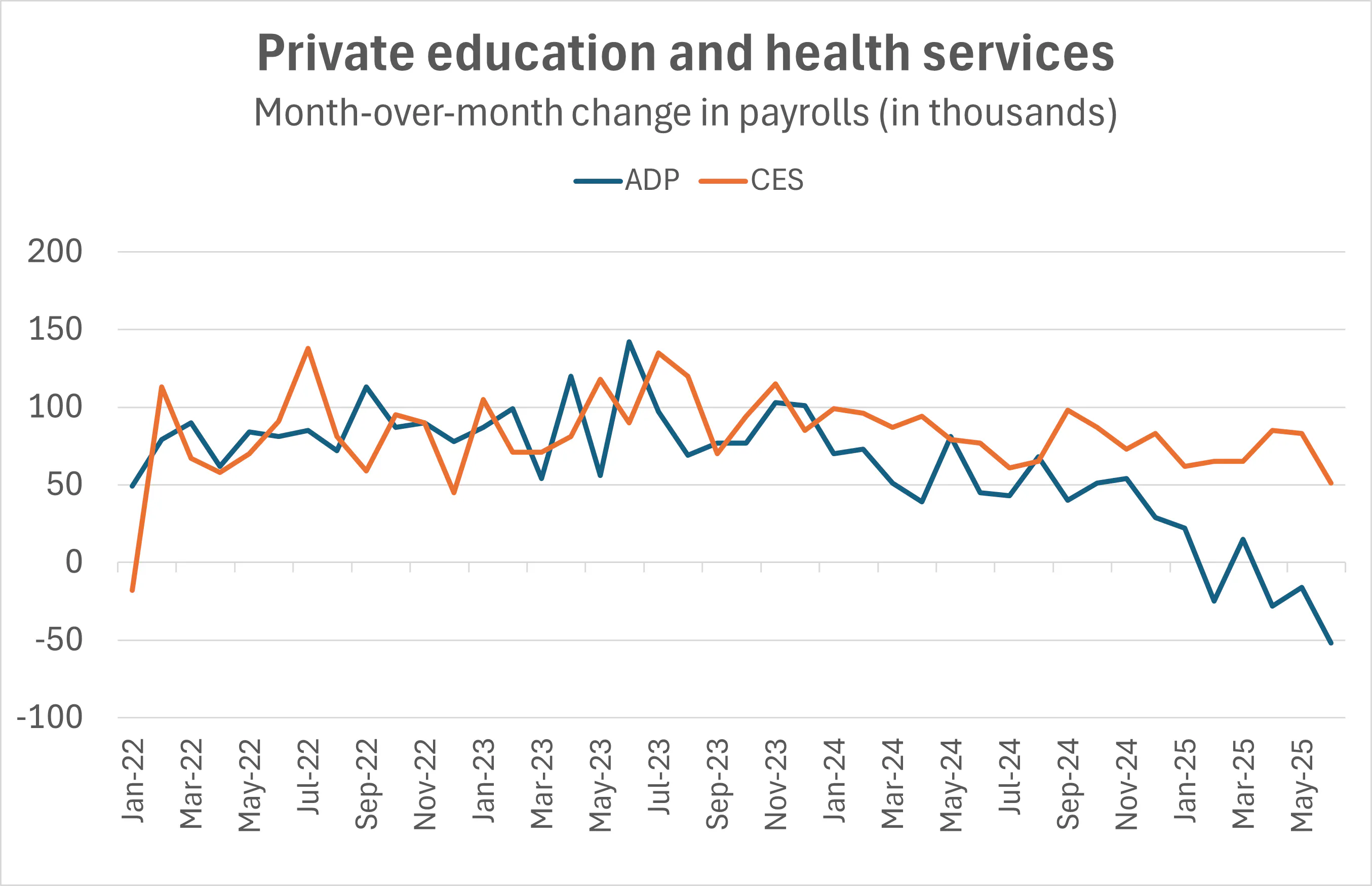
Source: bls.gov and adpemploymentreport.com
We offer all this discussion as context for why we are not willing to blindly assume that healthcare jobs will keep propping up U.S. job growth in perpetuity. Regardless whether you agree with us or not, one thing is now very clear - you need to have a view on this to have a view on the prospects for the overall U.S. job market.
State and Local government education
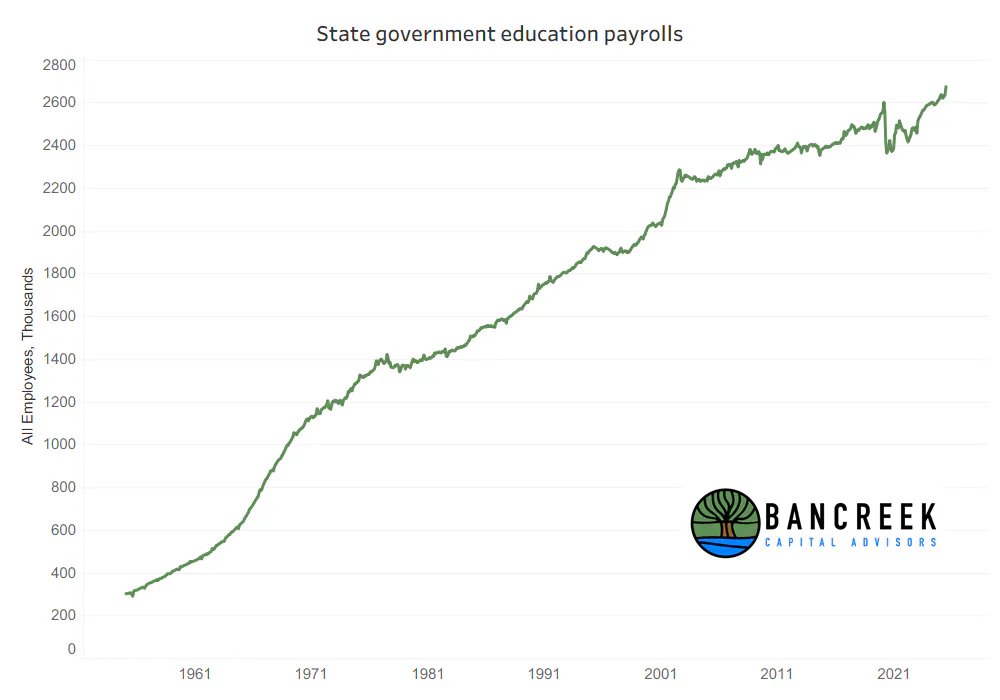
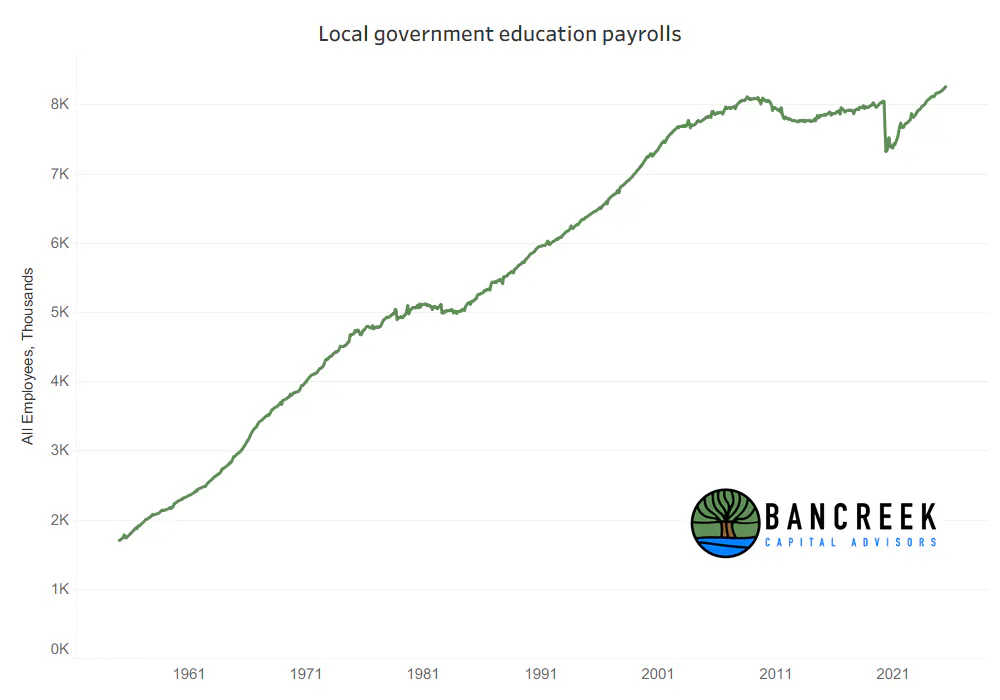
The other two pillars of job growth were State government education (+40,300 jobs) and Local government education (+23,200 jobs). For context, below is the historical trend chart for both of these industries:
Source: Bancreek Capital Advisors analysis of data from bls.gov
Source: Bancreek Capital Advisors analysis of data from bls.gov
Our take on these two charts is the longer term growth in both of these education industries has been relatively unimpressive.
Let's start with State government education. Over the past 20-years, State government education jobs are up 18.7%. That may seem like an impressive number, until you compare it to say, Individual and family services jobs (which are now at risk if Medicaid gets cut) which have risen 191.6% over the same time period. Local government education jobs are even worse than State government education jobs, having increased by just 5.7% over the last 20-years. So, without any further research, the data suggests that we bring some healthy skepticism to the staying power of June's surge in public education jobs.
While we are not experts in the outlook for public education, our skepticism only gets stronger when we do even the most cursory research on the space. Messaging from the current federal administration points to cuts to public education funding rather than increases in funding (not to mention the impact of NIH funding cuts on public research institutions). Also, if states have to shoulder a higher proportion of medical expenses for Medicaid, but don't want to kick people off Medicaid, other cuts will have to be made, which could hit education. At best, we'd characterize our 30,000-foot view on public education as not banking on this month's job growth to continue at a similar pace. At worst, you could make a convincing argument for job decline here.
Strong job market? Or lump of coal?
We've reached the end of this admittedly very word heavy post on June's NFP data. Now it's up to you to decide if today's data provided evidence of a robust job market, or was a lump of coal wrapped up in a pretty bow. Let's discuss on socials! You can find us on LinkedIn and X. So long that we are all rooting our opinions in data, we love to hear differing view points. We truly look forward to hearing from you!
Enjoying this post?
Tell others about it.

Bancreek's Actively Managed ETFs
If you are interested in learning more about Bancreek Capital Advisors' actively managed ETFs click the link below
Learn MoreMore articles like this
Fetching Related Posts
There are no other articles tagged with Research