Key takeaways from the December 2024 Consumer Price Index release

Eric Pachman
Published
January 15th 2025
Eric Pachman
Published
January 15th 2025
December 2024 year-over-year inflation comes in 14 basis points higher than prior month
This morning the Bureau of Labor Statistics released the December 2024 Consumer Price Index for All Urban Consumers (CPI-U). Overall CPI-U was reported at 2.89% year-over-year (YoY) for December, up 14 basis points from 2.75% YoY last month.
As a reminder, Bancreek publishes two visualizations that can help you explore CPI-U in granular detail. Both of these visualizations have now been updated through December and are embedded below:
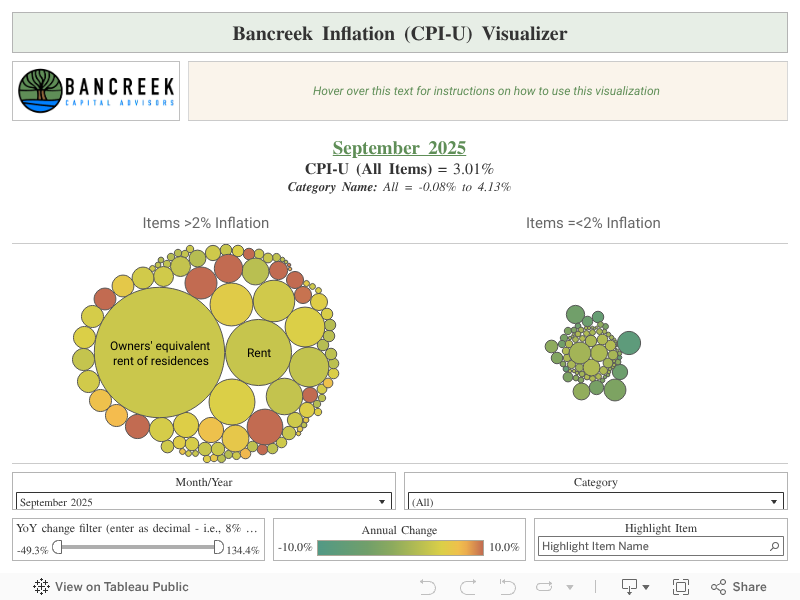
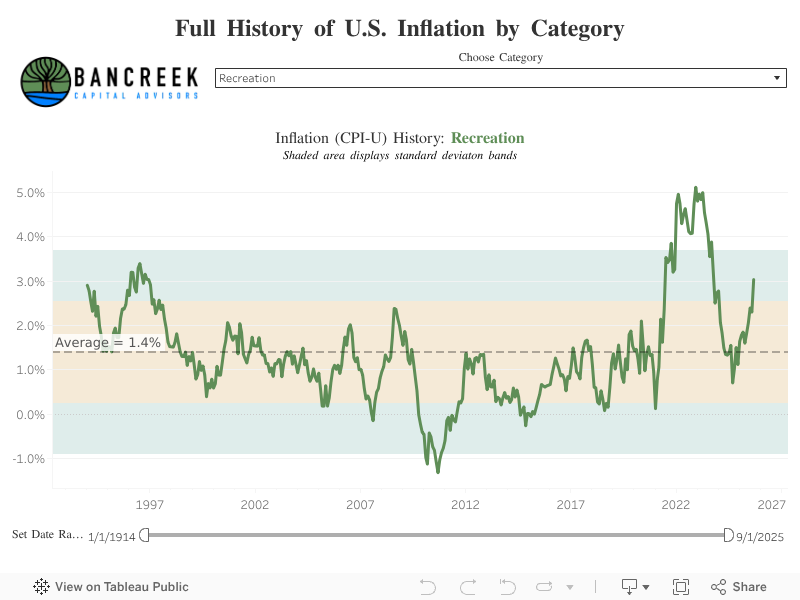
This post hopefully will further assist in your analysis of the moving parts underlying this month’s CPI-U print. Its goal is not to provide a comprehensive analysis of the nearly 180 items we track (that’s what the visualizations are for), but rather just to point to the most meaningful changes from one month to the next.
To perform this analysis, we track a measure we call “inflation impact,” which we calculate by multiplying each item’s YoY inflation by its weight in the prior year period. You can think of this as “weighted inflation” as opposed to the “unweighted inflation” that is more commonly reported by the media. Each month we take the weighted inflation of each item we track in CPI-U and then sum them up to overall CPI-U. Then we compare these weighted inflation numbers from one month to the next to see what drove the sequential increase or decrease. In this way, we can precisely identify the most significant drivers in the change in YoY CPI-U from one month to the next.
The items that changed the most in December
Our primary goal with our analysis each month is to explain the main drivers responsible for the change in CPI from the prior month to the current month. To that end, we have 14 basis points of additional YoY inflation in December when compared to November to explain. The following chart shows the items whose weighted inflation impact to CPI changed by +/-1 basis point. If you total all these items, you'll find that they added 17 bps to inflation, which means that the other 165+ items with a weighted inflation impact of less than +/-1 basis point totaled to -3 basis points. In other words, all the other stuff not on this chart largely cancelled out.
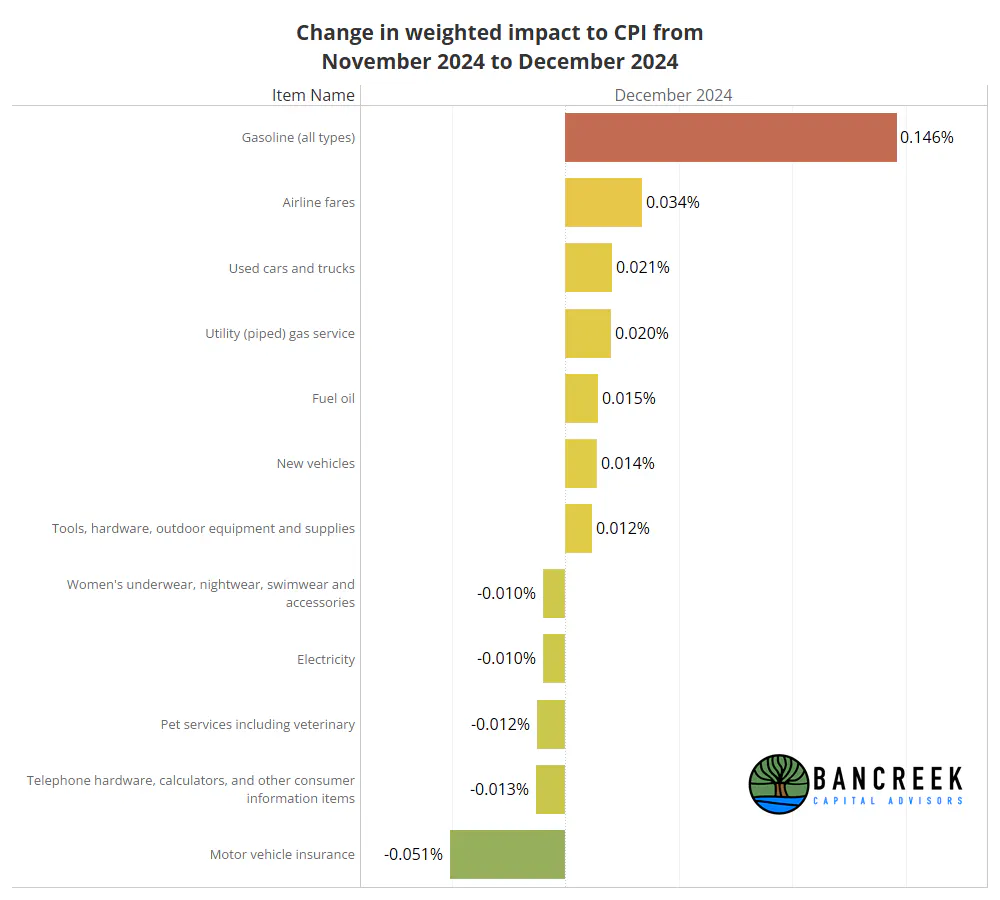
Source: Bancreek Capital Advisors, LLC
Don't be alarmed by Gasoline
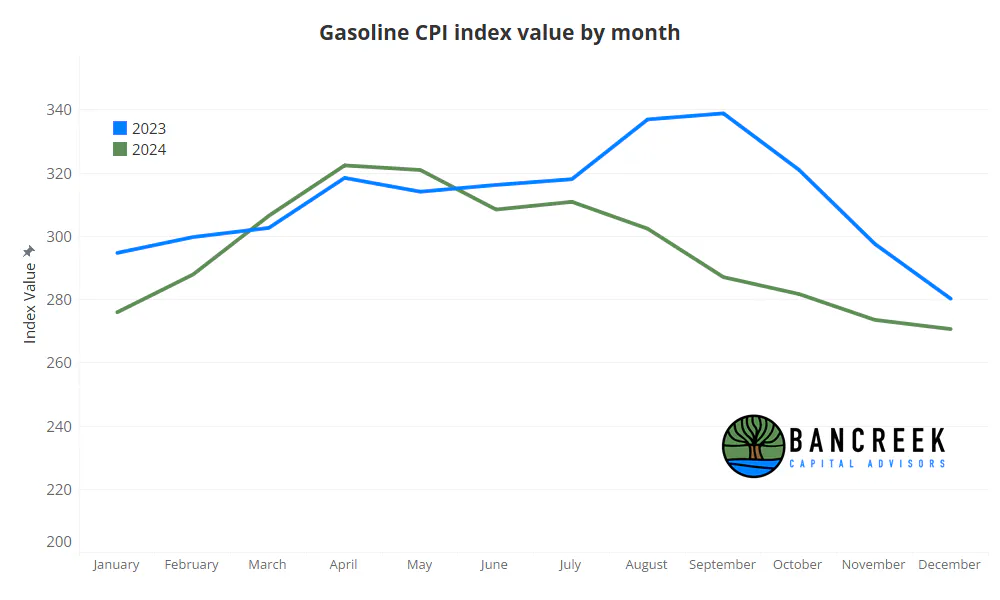
First off, don't be scared by the large bump in Gasoline. As we have written, Gasoline is largely known with high accuracy heading into each CPI print, so consensus shouldn't ever be surprised by this. Moreover, as shown in the below chart, what really happened here is we cycled a "tougher comp" in December than we did in November. In other words, average gasoline prices fell a lot more from November 2023 to December 2023 than they did from November 2024 to December 2024. As such, when we do the year-over-year calculation for both periods we see less deflation.
Source: Bancreek Capital Advisors, LLC
Motor vehicle insurance inflation continues to ease
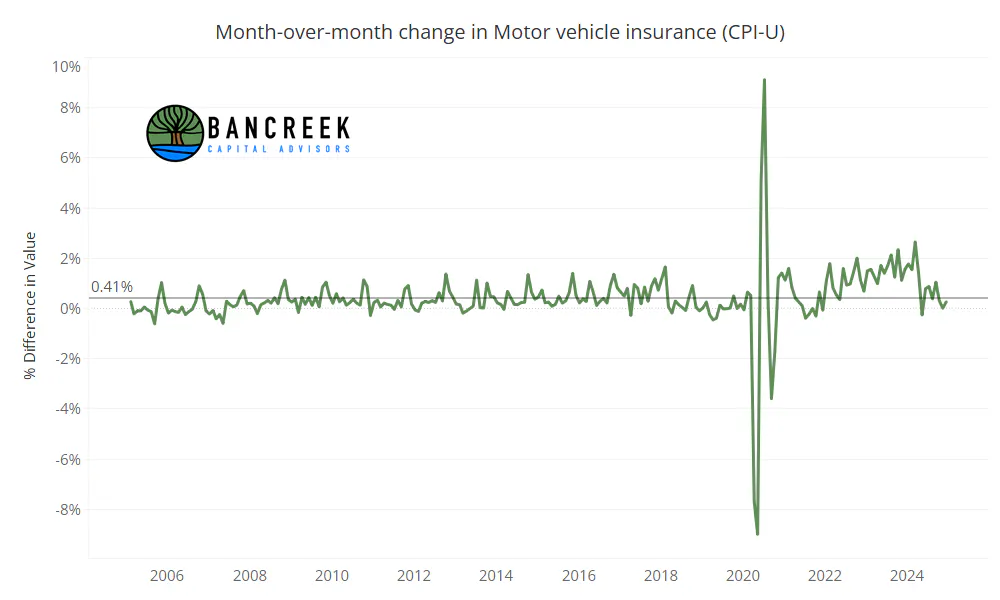
Meanwhile, on the favorable side of the chart, we once again see Motor vehicle insurance, which shaved over 5 basis points off CPI from November to December. December marks the third month in a row where month-over-month inflation for this item was subdued, which is a very welcome sign after averaging a whopping 137 basis points of month-over-month inflation going back to the start of 2023. Just to add some context here, 137 basis points of monthly inflation annualizes to a 17.7%! This month's 26 basis points of inflation annualizes to a much more reasonable 3.2%. This is a big deal looking forward as if the current month-over-month run rate continues, we calculate that this would shave 20 basis points off headline CPI by June 2025! That's a huge tailwind we have to look forward to, so long that this one item continues to cooperate.
Source: Bancreek Capital Advisors, LLC
No need to fret about Airline fares either at this point
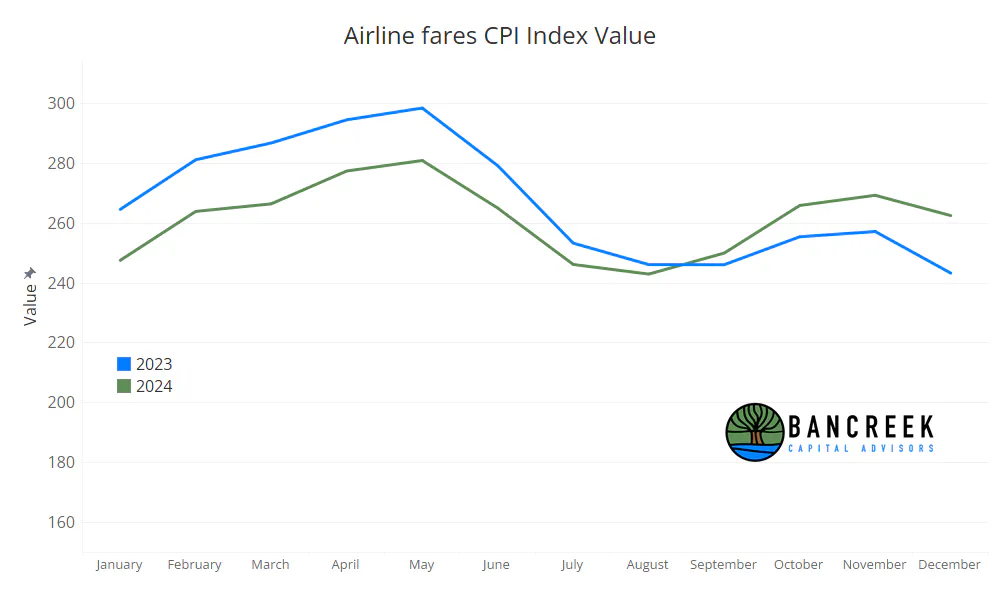
If there was an item that we could pick (outside of gasoline) to be "inflationary" in our walk across from one month to the next, it would be Airline fares. This is because if anything is going to add to inflation, it may as well be a highly volatile item that has historically flip flopped from one month to the next. Airline fares is one of these highly volatile items that can flip flop either way, but doesn't tend to stick in either direction. In fact, as shown below, the only reason why it's inflation impact rose from November to December was because it deflated less from November 2024 to December 2024 than it did from November 2023 to December 2023. It was the same situation we had this month with Gasoline - just a tougher comp situation rather than anything more concerning.
Source: Bancreek Capital Advisors, LLC
Higher food and beverage inflation offset by a decline in medical care inflation
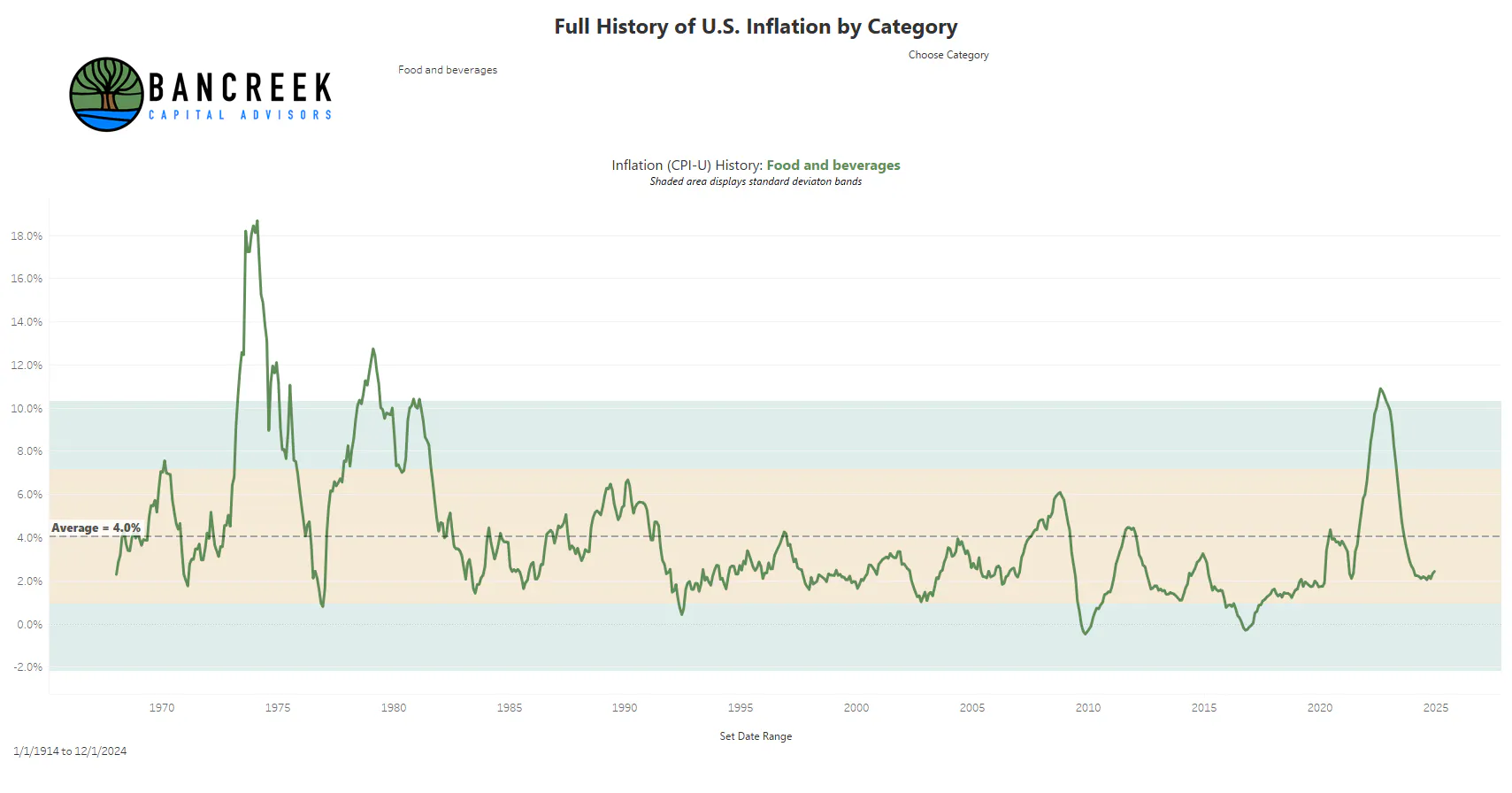
If we zoom out a level from the items and look at broader categories, we did see a touch more inflation in Food and beverage, which rose from 2.3% YoY to 2.4% YoY. With how the general media is covering the potential impact (especially on groceries) of whatever tariffs the new administration may put in place, watching this category feels like watching a slow motion train wreck. However, it's probably wise to not get too caught up in what the media tells us "could" happen and just focus on what is real today (that advice applies to life in general, by the way). So, all we can say for sure is that Food and beverage inflation remains at historically low levels.
Source: Bancreek Capital Advisors, LLC
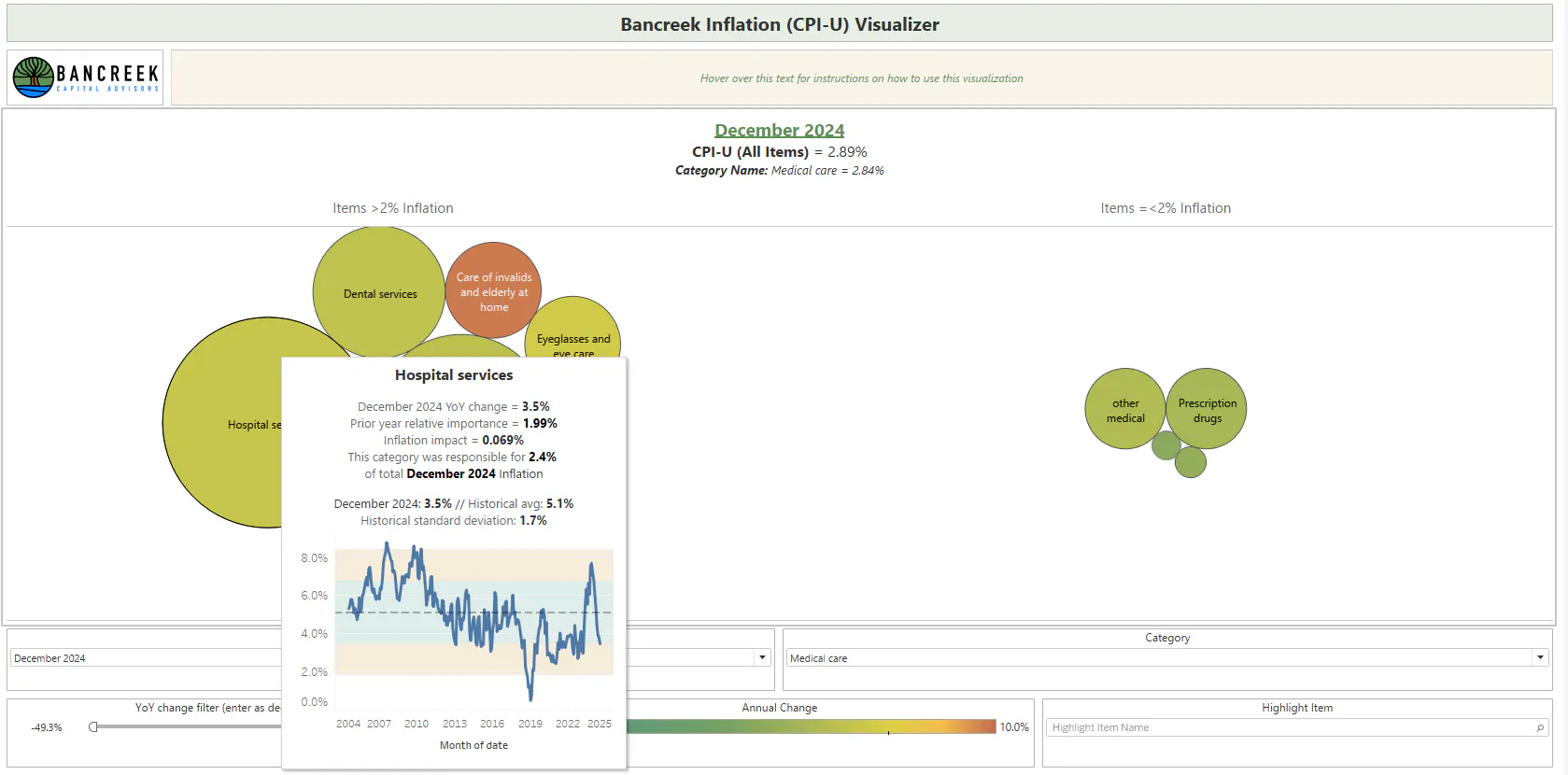
While Food and beverage may have risen a bit more than we would have liked to see, this was met by a surprisingly broad-based decline in YoY Medical care inflation from November to December.
If you didn't know this already, we've given you the ability to filter the Bancreek Inflation (CPI-U) Visualizer by Category. Below, we filtered it to display only the items in Medical care. Simply hover over each of the items to see its long-term trend. We've done this for Hospital services in the screenshot below, but if you were to hover over Physicians' services, Dental services, and Health insurance, you would see that inflation declined for each of those this month as well. This just goes to show to still expect the unexpected in these data releases!
Source: Bancreek Capital Advisors, LLC
What to expect from CPI in the coming months
Sometimes there are months when the headline/core numbers look good, but are hiding some nasty stuff underneath. If we had to summarize today's CPI data, it was the opposite of this. It looked great from a bird's eye view, and looked even better when studied up close. In fact, the modest inflation prints we got once again in Motor vehicle insurance and Shelter starts to build more confidence that their COVID-induced inflation is finally in the rear view mirror. And this is very important, because if it is true, it could have a significant positive impact on core CPI going forward.
To illustrate, we'll bring back our next six month scenario analysis just to show you the sensitivities to these key items. First, here's a summary of our three scenarios.
Low inflation scenario
- OER and Rents rise by 30 basis points MoM each month
- Used cars and trucks are flat MoM each month
- Motor vehicle insurance rises by 20 basis points MoM each month
- Gasoline increases by 1.5% MoM in January to get to the current January average as of 1/14, and then rises by its historical average (+47 basis points MoM) each month in February forward. This would be a very good (and maybe low likelihood) scenario as gasoline prices usually exhibit a seasonal rise in prices from winter to spring.
- All other items net to 1.1% weighted inflation, which implies stable food inflation and continuation of modest easing in medical care inflation
Medium Inflation Scenario
- OER and Rents rise by 35 basis points MoM each month
- Used cars and trucks rises by 20 basis points MoM each month
- Motor vehicle insurance rises by 40 basis points MoM each month
- Gasoline increases by 1.5% MoM in January to get to the current January average as of 1/14, and then by 2% each month through June to reflect modest seasonal rise in prices
- All other items net to 1.18% weighted inflation, which implies modest rise in food inflation without any additional assistance from medical care
High inflation scenario
- OER and Rents rise by 40 basis points MoM each month
- Used cars and trucks rises by 40 basis points MoM each month
- Motor vehicle insurance rises by 60 basis points MoM each month
- Gasoline increases by 1.5% MoM in January to get to the current January average as of 1/14, and then by 3.5% each month through June to reflect a more significant seasonal change in prices
- All other items net to 1.25% weighted inflation, which implies a more meaningful rise in food inflation and higher medical care inflation
Without further delay, here's what CPI could look like going forward in these three scenarios:

Source: Bancreek Capital Advisors, LLC
Here are a few key takeaways from this scenario analysis:
- First, don't expect to see much progress next month. It's quite clear that unless January's sequential inflation just plummets, the best realistic case for January 2025 CPI is to match December's 2.9%. But we wouldn't be surprised if we saw a three-handle in January. Again, that wouldn't be anything to be concerned about, but is more a function of January 2024's tougher comparison.
- After January, the CPI scenarios really start to diverge. It's not unreasonable to model it dropping as low as 2.2% in April if we keep getting these healthy sequential inflation prints for Shelter and Motor vehicle insurance AND we don't see any seasonal rise in gasoline prices (which again, would be a surprise).
- On the other hand, headline CPI could bottom at 2.9% before rising into the early summer if we end up in our high inflation scenario.
- The good news here is that the largest driver of the divergence in our scenarios is gasoline. The nature of the seasonality in prices simply dwarfs all other items. This is good news because we have all been told that the Fed cares more about core inflation, which removes gasoline, when setting rate policy. But we suspect stubbornly high headline numbers wouldn't help the perception that the U.S. is still struggling with inflation.
Core inflation appears to have some tailwinds going forward
While this post ended with a bit of a thud thanks to the uncertainty of the completely unforecastable gasoline boogeyman, we stand by our excitement that the more sticky core items have provided a nice set up for CPI going forward. Shelter and auto insurance appear to have finally rerated down, while medical care provided a surprising offset to what ended up being a modest rise in food inflation. We'll keep tracking CPI and PCE going forward and update our scenarios as the data changes! Make sure to join our distribution list to ensure that you get all our latest research and data visualization updates.
Let's discuss more about this topic on socials! You can find us on LinkedIn and X.
Enjoying this post?
Tell others about it.

Bancreek's Actively Managed ETFs
If you are interested in learning more about Bancreek Capital Advisors' actively managed ETFs click the link below
Learn MoreMore articles like this
Fetching Related Posts
There are no other articles tagged with Research