
May 2025 nonfarm payrolls: How long can health care carry U.S. jobs?

Eric Pachman
Published
June 6th 2025
Eric Pachman
Published
June 6th 2025
Nonfarm payrolls increase by 139k in April. Private payrolls up 140k.
Total nonfarm payrolls rose by 139,000, inclusive of a 140,000 increase in Total private jobs. Today's release also included a two-month payroll net downward revision of -95,000 jobs. This downward revision lowered April 2025's month-over-month job additions to 147,000 jobs, 133,000 of which were private jobs.
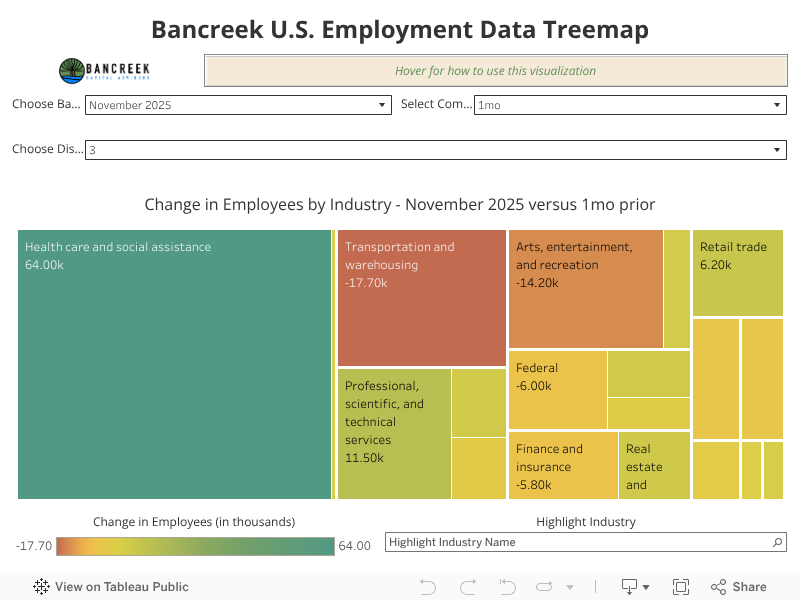
As always, you can explore all the data yourself using our the Bancreek U.S. Employment data treemap, which can be accessed here and also is embedded below. For an in-depth tutorial on how we built this visualization, and how to best use it, please read our Visualizing Changes in Nonfarm Payroll Data post.
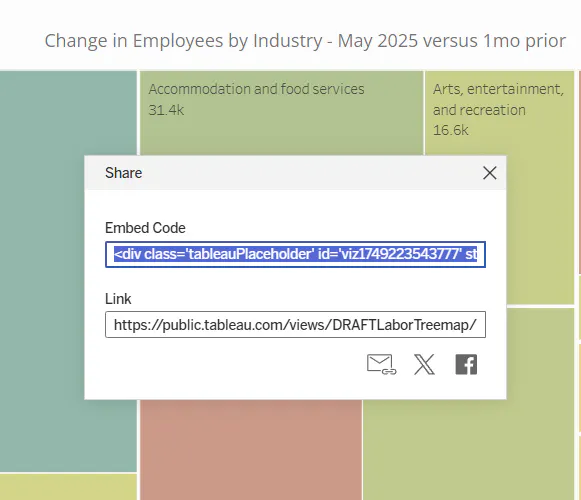
Before we dive into the data, did you know that you can embed the above data visualization on your website? Simply click on the "share" icon displayed at the bottom right of the viz, copy the embed code and bring it over to your site.
Health care remains the engine of U.S. job growth
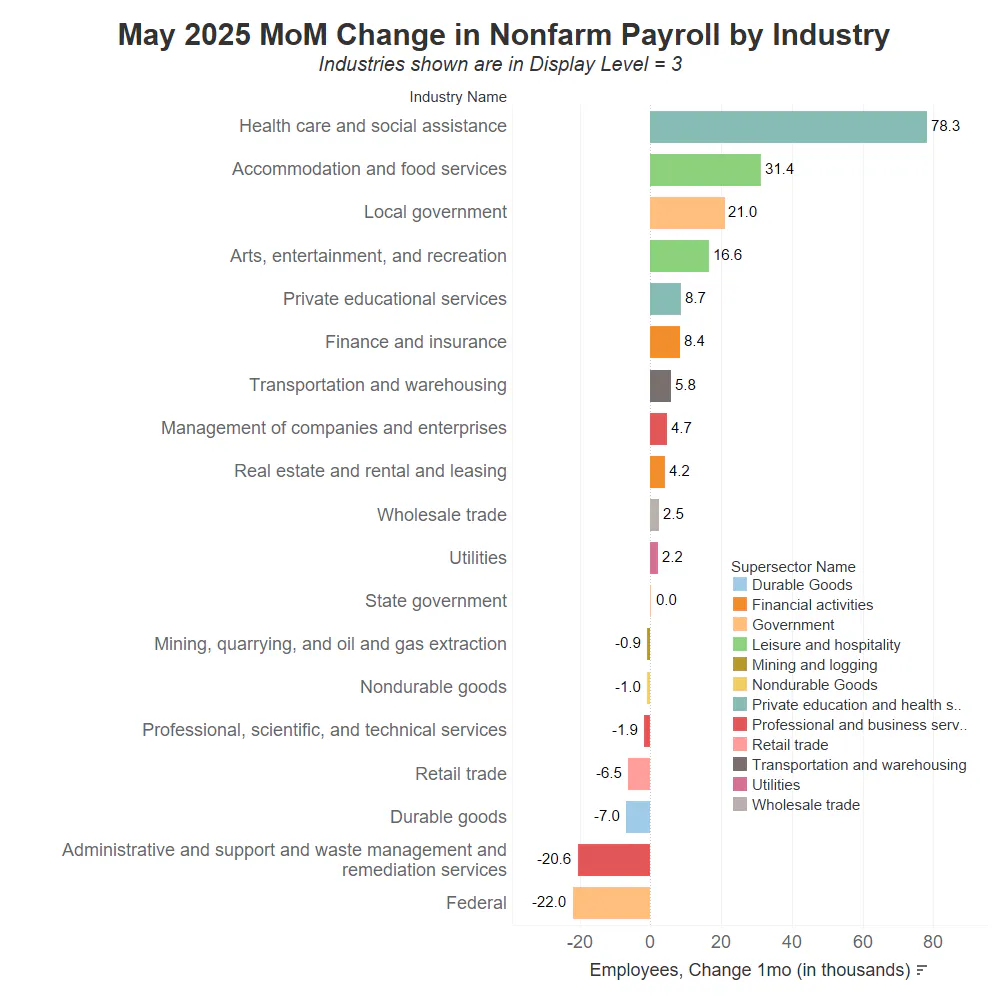
Once again, health care has asserted itself in the data, adding over 78,000 net new jobs month-over-month in May. The chart below shows Health care and social assistance job additions in comparison to all other Display Level = 3 industries (where a "Display Level" refers to the depth in the BLS' industry hierarchy, where the higher the number the more granular the industry).
Source: Bancreek Capital Advisors, LLC analysis of data from bls.gov
If you do the math, you'll find that 56% of all jobs added this month were in Health care and social assistance. For context, as of this month there are 23.2 million people employed in this industry, just 17% of the 136.0 million people employed in the private sector overall. So, 56% of our job growth this month came from just 17% of the workforce.
The wild part about this is that this industry actually underperformed its recent trend in May. Consider that over the past two years the U.S. has created 3.0 million new jobs. 1.9 million of these jobs were in Health care and social assistance. In other words, 63% of all net job growth over the past two years has come from Health care and social assistance.
Is health care's legendary job growth run now in jeopardy?
These data points should not inspire confidence in the U.S. economy. If we remove these health care jobs from our analysis of the payroll data over the prior two years, there were only 46k net new private jobs added over the prior two years - a level that is insufficient to maintain full employment.
As such, forecasting the future of U.S. payrolls has boiled down to an exercise of forecasting the future of U.S. health care jobs. With that in mind, let's review the escalating risks to the health care complex that have all transpired this year.
- Substantial cuts to NIH funding of medical research
- Proposed deep cuts to Medicaid (part of the One Big Beautiful Bill passed through the House)
- Proposed cuts to Medicare (now proposed by members of the Senate)
- The issuance of a most-favored-nation drug pricing executive order
- Escalating medical loss ratios, which are weighing heavily on health insurer corporate profits
While all of the above items pose downside risks to health care jobs, the proposed Medicaid cuts arguably could add the most direct risk to health care jobs, as Medicaid is the primary funder of a waiver program that pays for daycare for the elderly and disabled. These are centers that are far cheaper than institutionalized facilities (e.g., assisted living, nursing homes), and give caretakers the ability to hold jobs while their loved ones are being cared for during the day. While we are not experts on this sector, from a bird's eye view this seems like a win-win-win. States win as they see lower costs for elderly/disabled care. Caretakers win as they can hold day jobs. The economy wins as these folks are employed.
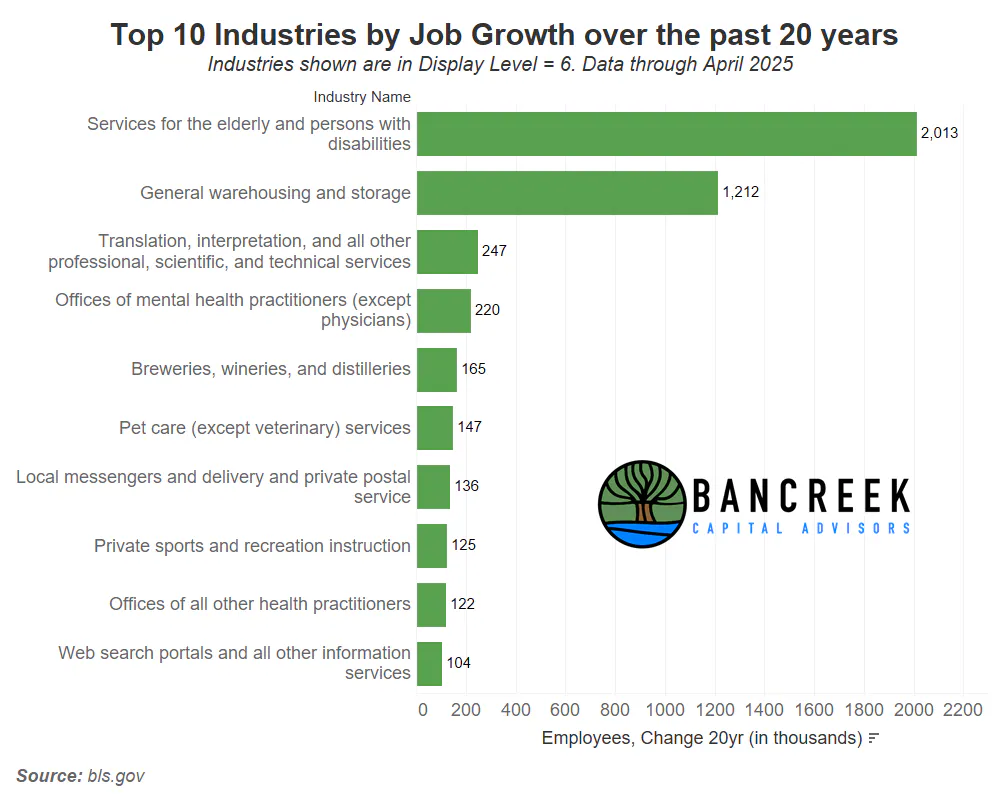
The proposed cuts to Medicaid put this all at risk. Note that the elderly/disabled daycare industry is not insignificant. As of May 2025, it employed 2.7 million people, and has grown faster than any other granular industry (within Display Level = 6) over the past 20-years. It is unclear how many of these jobs could be lost if the proposed Medicaid cuts are enacted.
Source: Bancreek Capital Advisors, LLC analysis of data from bls.gov
Other takeaways from today's labor data
We won't spend much time covering the other moving parts in today's payroll data release, as there is not much more to add besides the data we have cleaned up and visualized for you. Having said that, we'll add two quick call-outs. First, Federal government job losses accelerated in May to -22,000 MoM. However, as shown below this was almost fully offset by +21,000 net new Local government jobs, continuing the same trend we have seen all year.
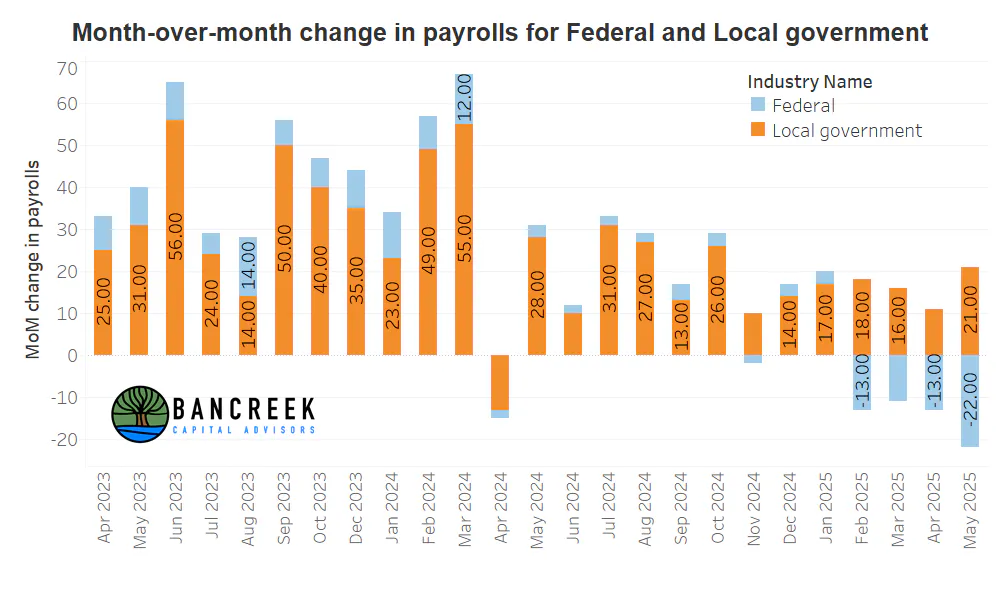
Source: Bancreek Capital Advisors, LLC analysis of data from bls.gov
The other call out this month is the continued strength in Food services and drinking places (which we'll call "restaurants" for short), which rose 30,200 MoM this month.
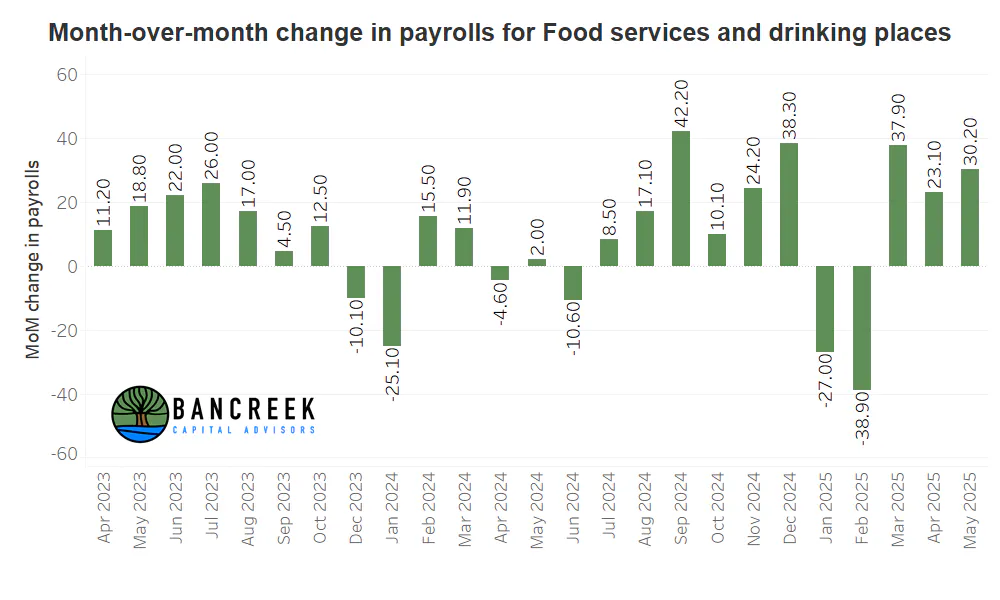
Source: Bancreek Capital Advisors, LLC analysis of data from bls.gov
To be fair, this is strong growth for this industry, which has averaged 13,800 MoM growth dating back to 1990. However, restaurant spend could be argued to be a largely discretionary expense, and therefore economically sensitive. In other words, if health care jobs get hit, dragging down overall jobs, it seems unlikely that restaurant hiring can ramp up to fill the job void. Rather, if health care job growth wanes (or even goes negative) it seems more likely to pull restaurant job growth down with it as discretionary spending contracts.
Just to add more context to our hypothetical musings on this topic, take a look at the following chart, which shows the history of restaurant payrolls dating back to 1990, overlayed with grey shading indicating recessions. This chart shows what we all generally would expect: restaurant hiring is economically sensitive, either stalling or contracting during the past four recessions.
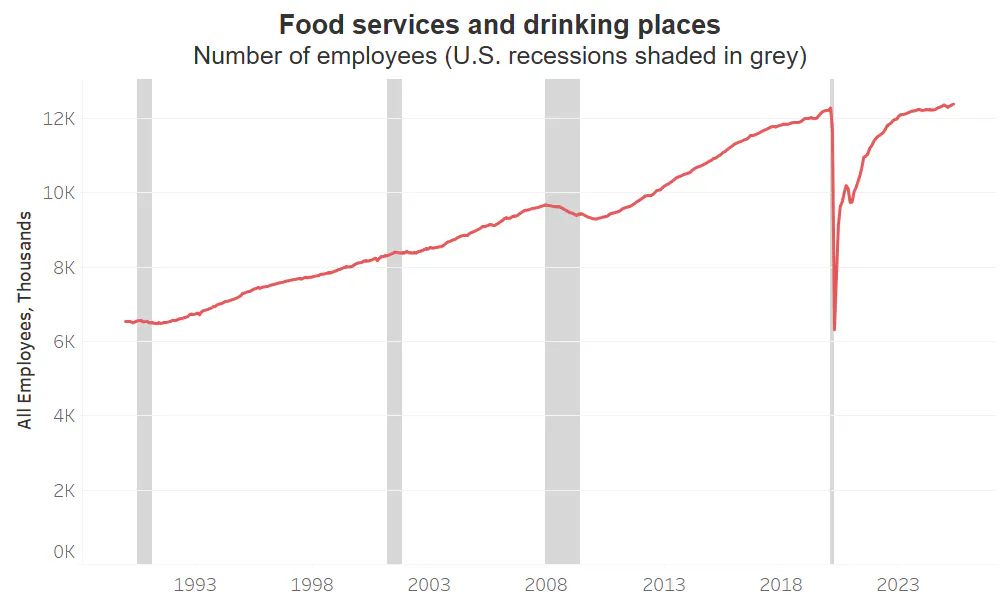
Source: Bancreek Capital Advisors, LLC analysis of data from bls.gov
This insight may not have surprised anyone. But we offer it as contextual setup to the next chart, in which we show Health care and social assistance payrolls over the same period.
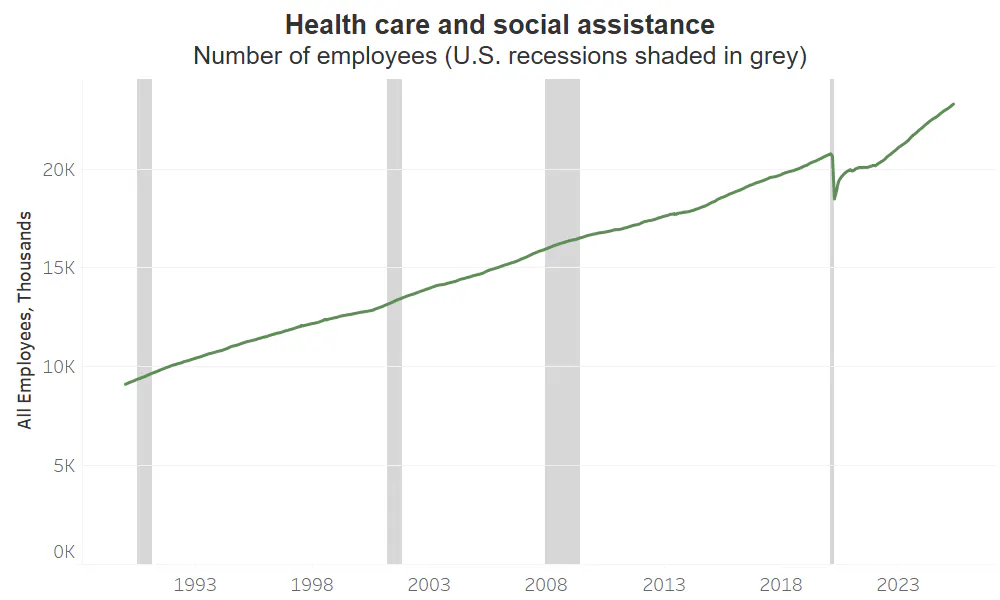
Source: Bancreek Capital Advisors, LLC analysis of data from bls.gov
The chart detailing health care job growth reveals a stark contrast to the restaurant sector, showing uninterrupted health care employment increases through each recession since 1990. While COVID prompted a temporary correction due to widespread shutdowns, the sector rapidly recovered from 2022 onward. Between 1990 and 2019, health care added an average of 32,200 jobs per month, jumping significantly to an average of 76,100 jobs per month from 2022 through May 2025.
Considering this resilience, it's worth reflecting on the factors driving such steady growth independent of economic cycles and monetary policy. The sustained expansion of health care jobs primarily stems from governmental policy shifts, such as Medicaid expansion, Medicare Part D, the rise of Medicare Advantage, Managed Care Medicaid, and increased administrative complexities through multiple intermediaries. These policy changes significantly broadened health coverage but also introduced systemic inefficiencies, excessive costs, and complexities criticized by politicians, media, and the public alike.
Notably, monetary policy—Federal Reserve interest rates specifically—had minimal impact on creating this sprawling health care ecosystem. The industry evolved incrementally through various policy initiatives. Currently, the sector faces a confluence of policy-driven challenges aimed at reforming perceived inefficiencies. However, given the interconnected nature of the health care system, broad policy actions targeting undesirable elements risk inadvertently harming beneficial aspects, particularly employment. This situation exemplifies the classic dilemma of potentially discarding valuable outcomes (such as substantial job creation) when addressing undesirable issues (inflated costs, pricing opacity, and waste).
Ultimately, this leads us to question the prevailing market focus on Federal Reserve rate cuts. If the health care sector has historically proven largely unresponsive to monetary interventions, why would interest rate adjustments effectively counterbalance imminent policy-driven employment losses? Perhaps the more critical consideration is understanding the potential economic fallout if anticipated Fed rate cuts are insufficient to offset significant reductions in health care jobs.
For more in-depth reports, interactive visualizations, and strategic market insights, visit our homepage and discover the latest from Bancreek Capital Advisors.
Enjoying this post?
Tell others about it.

Bancreek's Actively Managed ETFs
If you are interested in learning more about Bancreek Capital Advisors' actively managed ETFs click the link below
Learn MoreMore articles like this
Fetching Related Posts
There are no other articles tagged with Research