
Excluding Healthcare, the U.S. Labor Market is Contracting

Eric Pachman
Published
February 12th 2026
Eric Pachman
Published
February 12th 2026
Yesterday, the Bureau of Labor Statistics released its Employment Situation report for January 2026. In it, we learned that U.S. employers added 130,000 jobs in January, month-over-month. Where did those jobs come from? As usual, healthcare and social assistance.
Bancreek Capital Advisors got you covered on all the details in the latest release in our updated interactive data visualization (embedded below).
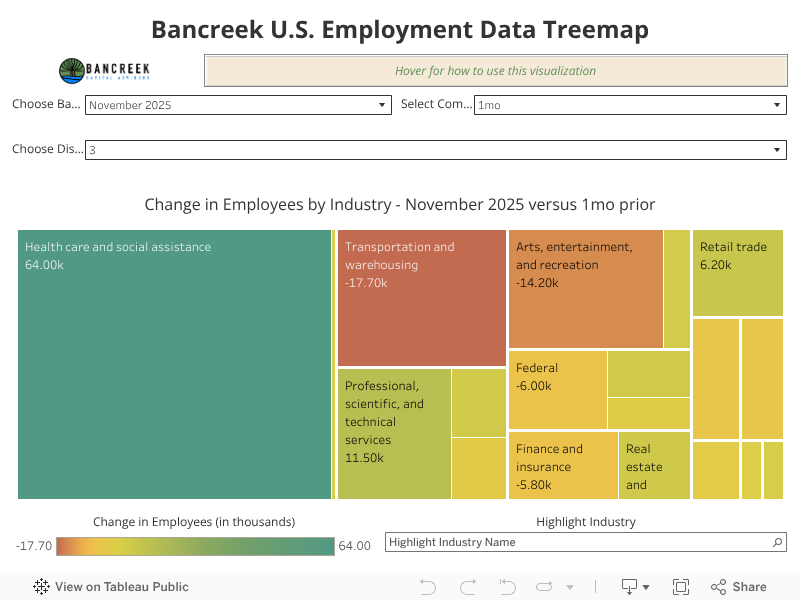
Healthcare is now all that is keeping the job market from meaningful contracting
First off, note that we changed the default view on the data visualization from MoM to YoY. Why do this? Because we think it's important to see not only the current month, but the carnage the BLS wrought on the data as a result of its annual birth-death model adjustment (which reduced 2025 net job adds from 584,000 to 181,000).
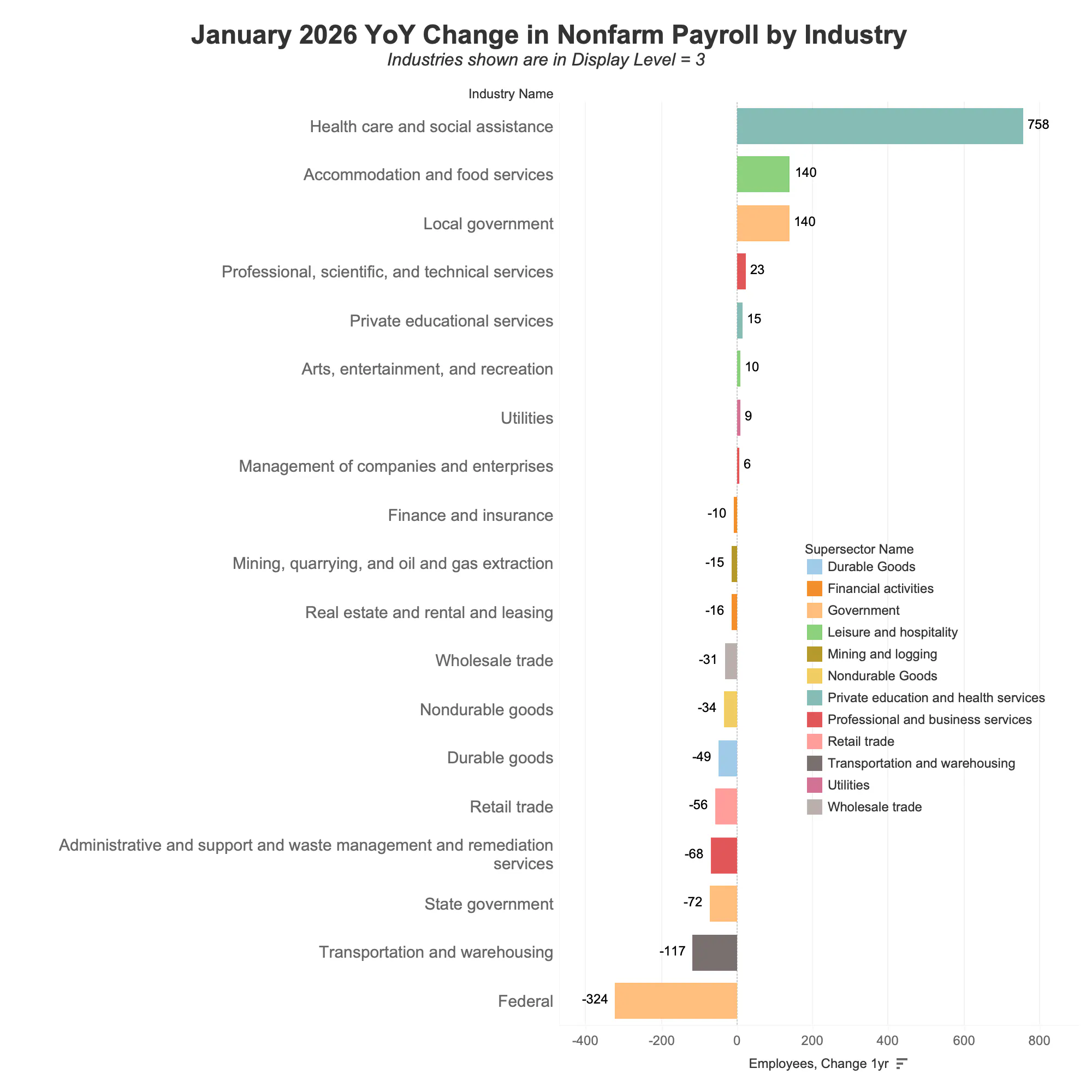
Anyway, you'll now see that over the past year the U.S. added 758,000 jobs in Healthcare and social assistance. Switch the visualization to Display Level = 0 and you'll see just 359,000 overall new jobs. In other words, we lost -399,000 jobs outside of Healthcare and social assistance from Feb 2025 through Jan 2026. This is not just mildly negative anymore. It's a meaningful decline. This divergence between headline job growth and underlying sector weakness has been developing over recent months, as highlighted in our January 2026 jobs report
The following chart shows the same information in a bar chart (for Display Level = 3). Outside of +140,000 jobs in both Accommodation and food services and Local Government, no other industries grew by more than 23,000 over the past year and 11 contracted.
Source: Bancreek Capital Advisors analysis of data from bls.gov
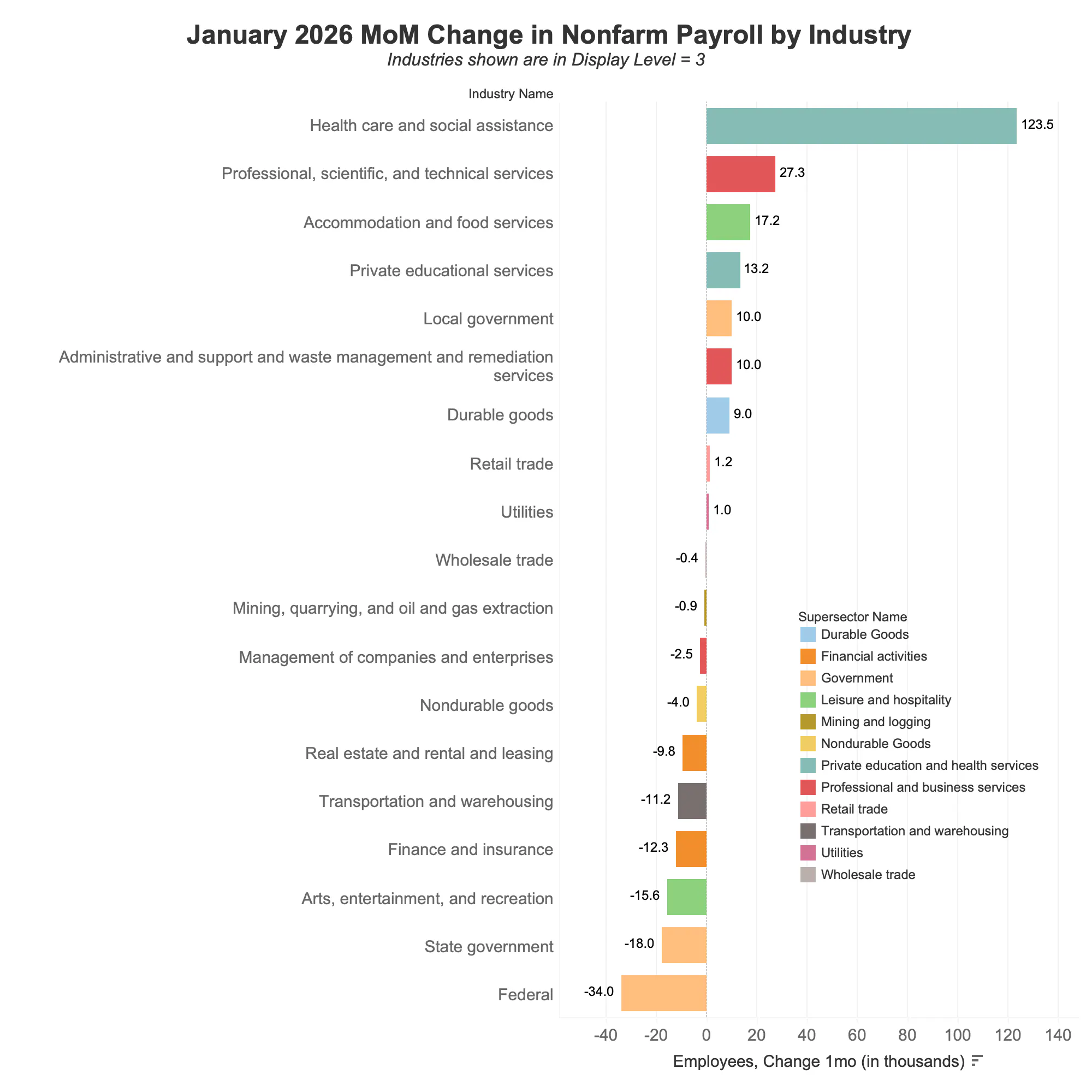
Here's the same view for the month-over-month changes. Different time period, same story: 123,000 of the 130,000 jobs added in January were in Healthcare and social assistance.
Source: Bancreek Capital Advisors analysis of data from bls.gov
All jobs are not created equal
If you’ve been following our work, you’ve heard the refrain before: Healthcare and social assistance is driving nearly all private job growth in the U.S.
Unfortunately, the concentration is getting worse.
It was less than a year ago when we were sharing the statistic that two-thirds of all private jobs created over the past two years were in Healthcare and social assistance. That percentage is now up to 114%!
Concentration risk in the U.S. labor market is no longer theoretical. It is extreme.
Why does it keep rising? There are several structural forces at work, but the dominant one is demographic reality.
According to the U.S. Census Bureau’s ACS 1-year survey, the share of the U.S. population aged 60 and older increased from 19.5 percent in 2014 to 24.4 percent in 2024. That translates to roughly 21 million additional Americans over the age of 60 in just a decade.
An aging population consumes more medical care. Eventually, many require assistance with daily living. That demand does not fluctuate with economic cycles. It compounds. This is a clear example of how long-term structural forces can shape economic outcomes beyond traditional business cycles, a theme explored in how we interpret broader economic signals. The result is an employment engine heavily skewed toward elder care and assistance services.
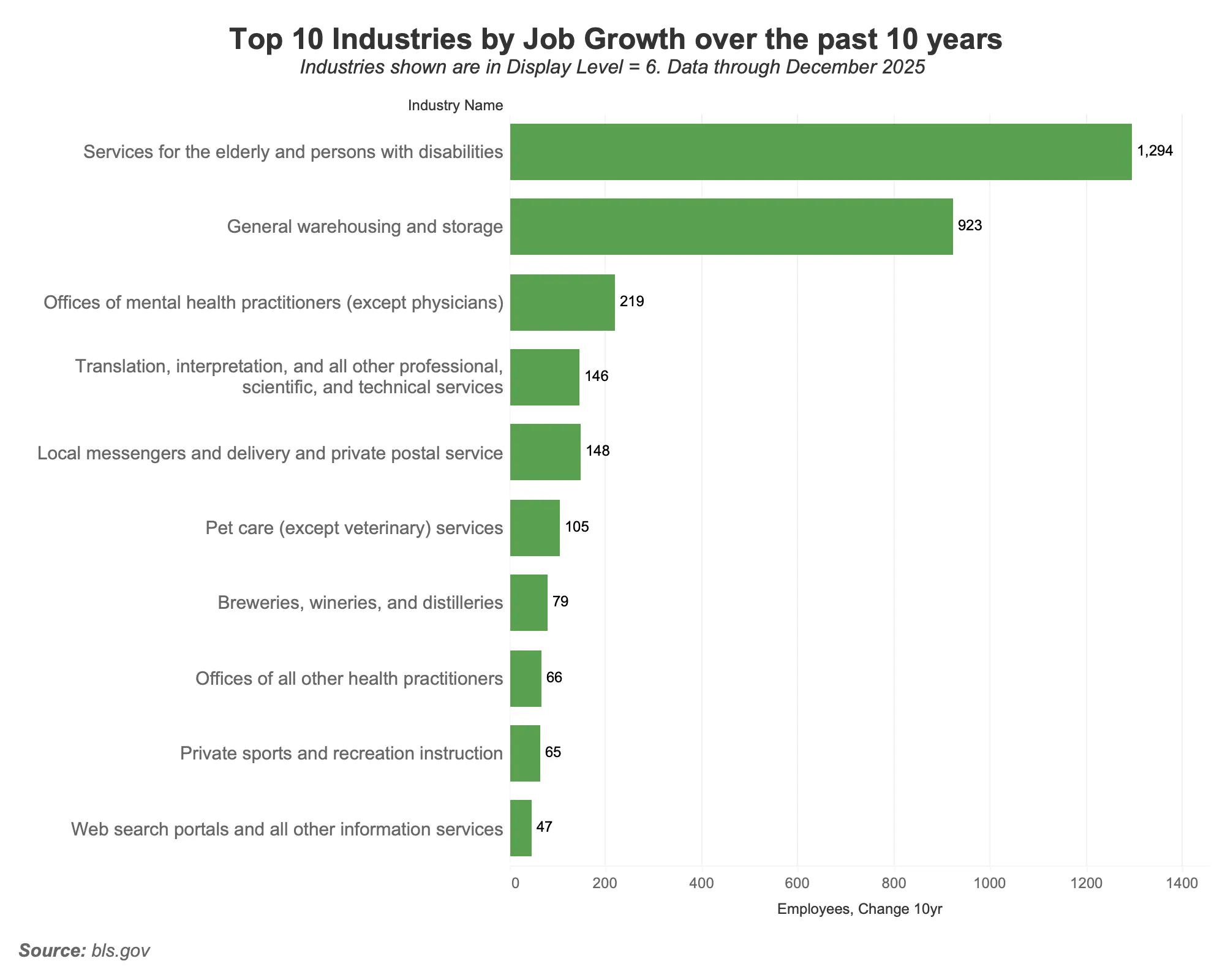
The single fastest-growing granular industry tracked by the Bureau of Labor Statistics over the past decade is Services for the Elderly and Persons with Disabilities.
This segment alone has added nearly 1.3 million jobs over the past ten years, more than any other detailed industry classification.
Source: Bancreek Capital Advisors analysis of data from bls.gov
What's most fascinating is that in 2025, Services for the elderly and disabled persons has added 281,400 jobs. Overall nonfarm payrolls were up 181,000 in 2025. So, you could argue that taking care of our growing elderly population was the single largest reason we didn't lose jobs in 2025.
But all jobs are not created equal, at least not for the economy. Clearly, a $250,000 job is much more valuable to the economy than a $25,000 job. So, the next logical question is how much do people working in the Services for the elderly and disabled persons industry make? Are these highly valuable jobs that are creating considerable amounts of disposable income? Or are the jobs that pay just enough keep workers out of poverty?
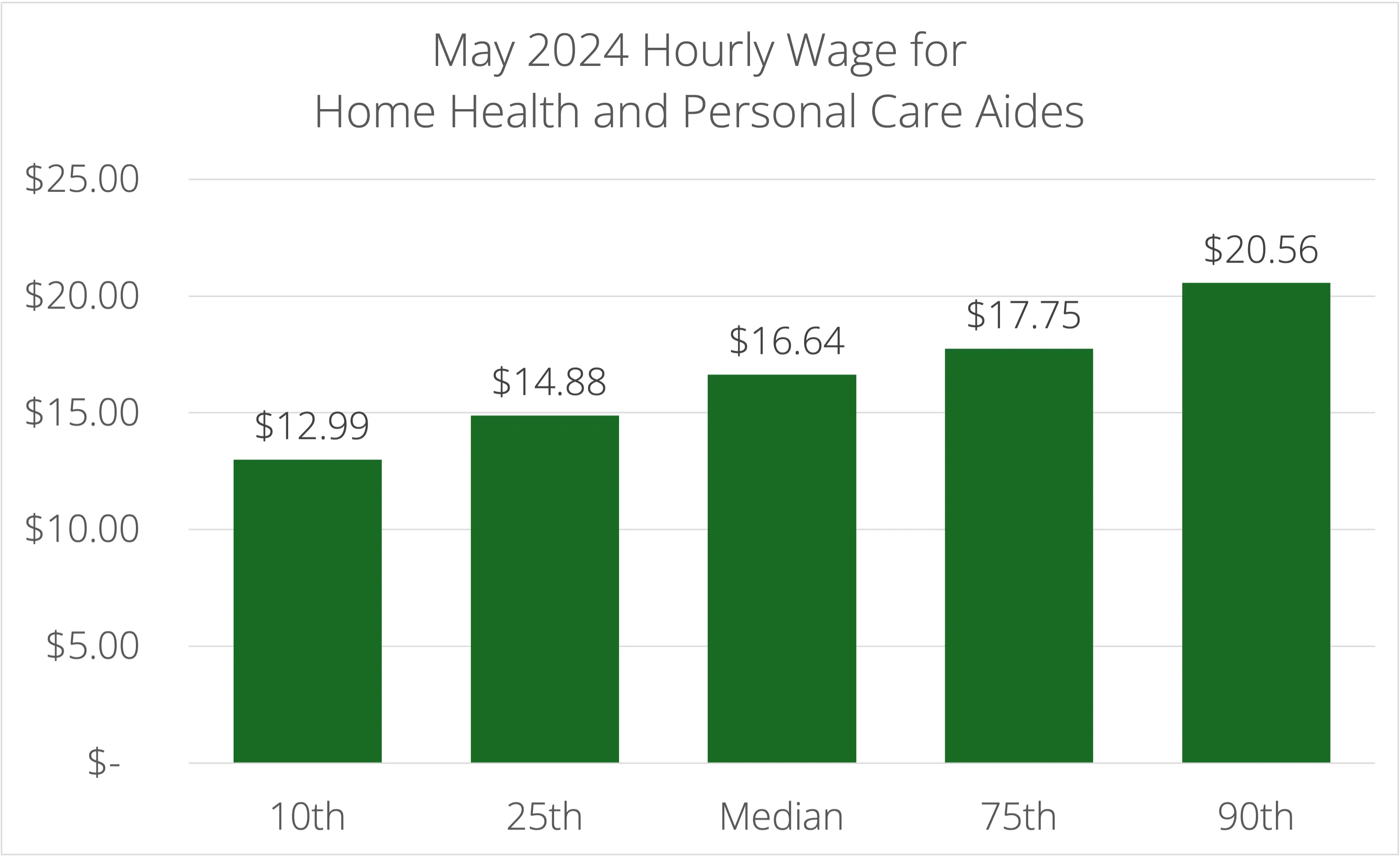
We can answer that using data in the 2024 Occupational Employment and Wage Statistics (OEWS) database. Based on this data, roughly 80% of the employees in this industry are Home Health and Personal Care Aides. In May 2024 (the latest data available), here is what hourly wages were for Home Health and Personal Care Aides, by percentile.
Source: Occupational Employment and Wage Statistics (OEWS)
In summary, the median hourly rate for the largest engine of job growth in our economy is $16.64. On an annualized basis that's under $35,000, which is over $4,000 below the Supplemental Poverty Threshold for a family of four.
All eggs in the healthcare basket
It's increasingly clear that the analysis of the U.S. job market is one and the same with the analysis of the Healthcare and social assistance jobs market.
The good news is America is only getting older, which will only increase demand for these low paying healthcare support positions.
The bad news is that the coming Medicaid cuts (2027) are likely going to take a severe toll on the Services for the elderly and disabled persons industry as it is largely funded by Medicaid waivers (Home and Community Based Services), which will likely be first on the chopping block when states look to cut costs.
So, maybe healthcare jobs can keep chugging along through 2026? But after that, all bets are off. The U.S. may lose its last remaining engine of job growth.
Enjoying this post?
Tell others about it.

Bancreek's Actively Managed ETFs
If you are interested in learning more about Bancreek Capital Advisors' actively managed ETFs click the link below
Learn MoreMore articles like this
Fetching Related Posts
There are no other articles tagged with Research